
About the Journal
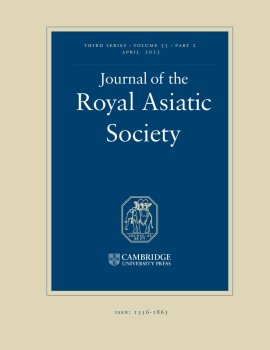
The Journal of the Royal Asiatic Society is a double-peer-refereed quarterly Journal of international acclaim with universities and other scholarly institutions throughout America, Europe, India, Australia and the Far East subscribing to us. We publish four times a year and our remit is extensive, covering the entire length and breadth of Asia from earliest historical times up until the 1980s and, as we publish material from a variety of disciplines – history, art history, linguistics and religious studies – we can provide a well-tailored platform for the publication of research that itself takes a multi-disciplinary approach.
The Journal awards three prizes on a bi-annual basis for exceptional articles: the Barwis Holliday Award for an article on an East Asian topic, the Staunton Prize for an article by a new scholar, and the Boyce Award for articles on an Asian religion.
To be alerted when new content becomes available for the Journal, please sign up for electronic table-of-content alerts in the Journal homepage here. You can also read a freely accessible sample article from the Journal here: Jurisdictional Politics in Canton and the First English Translation of the Qing Penal Code (1810).
Editorial Boards

Editor
Professor Daud Ali
The Department of South Asia Studies
University of Pennsylvania
820 Williams Hall
255 South 36th Street
Philadelphia, PA 19104-6305
daudali@sas.upenn.edu
International Editorial Board
Professor Muzaffar Alam, University of Chicago, USA
Professor Seema Alavi, Jamia Millia Islamia, New Delhi, India
Professor Jere Bacharach, University of Washington , USA
Professor Timothy Barrett, SOAS, University of London, UK
Professor Edhem Eldem, Boğaziçi University, Turkey
Professor Carl Ernst, University of North Carolina at Chapel Hill, USA
Professor Richard Gombrich, University of Oxford, UK
Professor Andrew Gordon, Harvard University, USA
Professor Edmund Herzig, University of Oxford, UK
Professor Sepp Linhart, University of Vienna, Austria
Professor Rana Mitter, University of Oxford, UK
Professor Tariq Rahman, Quaid-i-Azam University, Pakistan
Professor Anthony Reid, UCLA, USA
Professor Richard G. Salomon, University of Washington, USA
Professor Oktor Skjaervo, Harvard University, USA
Professor Nancy Steinhardt, University of Pennsylvania, USA
Professor Roel Stercx, University of Cambridge, UK
Professor Wang Gungwu, National University, Singapore
Professor Muhammad Q. Zaman, Princeton University, USA
Editor Emerita
Professor Sarah Ansari
Journal Editorial Board
appointed until end December in the year shown
Dr Andrea Acri (2026)
Professor Blain Auer (2025)
Dr Thomas P. Barrett (2028)
Dr Evrim Binbas (2027)
Dr Jaimee Comstock-Skipp (2028)
Dr Arthur Dudney (2027)
Professor R Michael Feener (2027)
Professor Finbar Barry Flood (2026)
Professor Peter Frankopan (2028)
Dr Aparna Kapadia (2028)
Dr Mahmood Kooria (2028)
Dr Lars Laamann (2027)
Professor Timothy May (2025)
Professor F C R Robinson (2025)
Dr Taylor Sherman (2026)
Dr Weipin Tsai (2026)
Professor Nancy Um (2026)
The President and Director (ex officio)
Submissions and Proposals
Authors who wish to submit articles for consideration by the JRAS editorial team should do so through ScholarOne at Cambridge University’s Cambridge Core (you may need to create an account first). Please click on the link below.
https://mc.manuscriptcentral.com/jras
All non-European characters should be rendered in Unicode. The editorial team is committed to appraising all submissions as quickly as possible. The Harvard system should not be used. References should be formatted as footnotes, and not endnotes, thus:-
- G. H. Luce, Phases of pre-Pagan Burma: Languages and History (Oxford, 1985), i, pp. 171-178.
- C. E. Bosworth, “Ghaznevid Military Organisation”, Der Islam, XXXVI (1960), pp. 40-50.
- M. Sharon, “The Ayyubid walls of Jerusalem”, in Studies in Memory of Gaston Wiet, (ed.) M. Rosen-Ayalon (Jerusalem, 1977), pp. 179-195.
Transliterations should be consistent within any given article. Illustrations are welcomed if they contribute to the academic thrust of a paper but authors should be aware that colour publication is possible online only, not in print publication which will be in black and white.
The Journal has a soft limit of 15,000 words for articles. Any submission longer than this must be agreed ahead of time with the editor.
The JRAS typically publishes one or two Special Issues per year. If you are interested in making a proposal please fill in and return this form to Matty Bradley at mb@royalasiaticsociety.org.
The annual volume, including any Special Issues, must stay within the Journal’s page budget. If a Special Issue is larger than the average issue allowance then the other issues in the same volume year will need to accommodate for this fact (by being smaller). Special issues are generally in the range of 160–220 printed journal pages, and must not exceed 220 pages. This is about 75,000 words, with a maximum of 95,000 words, taking into account the use of tables and figures.
JRAS Guidelines
This version of guidelines was issued by the JRAS Editorial Office in November 2021.
Construction of manuscript files
It is important that authors do not copy and paste references or bibliographic material from online sources as this often results in the importation of metadata. Please retype your entries.
General layout
- All articles (text and footnotes) must appear in double spaced text throughout.
- Main text should be size 12 point, Times Roman font (except for foreign characters and diacritics). Left and right justified.
- Abstract and footnotes should be size 10 point, Times Roman font. Left and right justified.
- The title of the article and the author’s name, should appear at the beginning of the article (all centred 12 point Times Roman font). Author’s affiliation and email address (preferably linked to your institution) should be present at the end of the article (ranged right).
- A ‘short’ title (no more than 30 characters, including spaces, to be used as the running head in the published article), should be provided.
- An abstract of maximum 200 words summarising the content of the article should be appear before the main text.
- Sub-headings must be used to break up articles.
- Do not use Roman numerals as section headings.
Please follow the JRAS ‘house style’ outlined in the notes below. For matters that are not covered in these notes, please refer to the New Oxford Style Manual, third edition, 2016.
- Spell out centuries: i.e. ‘nineteenth century’ rather than ‘19th century’, ‘tenth century’ rather than ‘10th century’, etc.
- Spell out numbers 1–10: i.e. ‘one’, ‘two’, ‘three’, etc. All other numbers should be represented as numerals.
- Spell out %: i.e. ‘15 per cent’.
- Em-dashes should be used when punctuating text.
- ‘c.’ should always be spelled out and italics: ‘circa’.
- In references, there should be a space between ‘p.’ and its number, i.e. ‘p. 15’. ‘ed.’ and ‘eds.’/ and trans. should be in () brackets.
- A person’s initials should have a space: i.e. R. D. Hume.
- With footnote layout, please follow rules below, and maintain consistency.
- Please use ‘and’ rather than ‘&’, especially when referring to authors.
- Please spell out, at first mention, all acronyms and initialisms.
- Long quotations should be size 11 point, Times Roman font. Left and right justified, with one line spacing above and below main text. Paragraphs should be ranged left with one line space between each, and not enclosed in quotation marks. All quotations must be acknowledged and fully referenced within a footnote.
- Use double inverted commas for short quotations and phrases within the main text, then single quotations for quotes-within-quotes.
- Tables should be clearly laid out and numbered consecutively. Vertical lines between columns should be omitted, if possible.
- All British spellings, ‘s’ rather than ‘z’ for …ise/ization (materialise, constitutionalise, etc.), and, for example, ‘analyse’ not ‘analyze’, ‘colour’ not ‘color’, ‘programme’ not ‘program’. Double ‘ll’ in verbs for example ‘travelling’.
- Please use the phrase ‘this article’ rather than ‘this essay’ or ‘this paper’.
- Dates: English format please, i.e. day, month, year, i.e. 14 July 2009.
- Figures, and totals in tables, references and footnote numbers should be checked for accuracy.
- Paragraphs (except directly under a heading, where they should be flush left) should be indented by 4mm, with no line space.
- Section (A) headings should be 12 point, bold, centred, with one line space above and below, with initial upper case only except for proper nouns, i.e. ‘The political economy of Uttar Pradesh and the mobility saga’.
- Second level (B) headings should be 12 point italic, centred, with one line space above and below.
- Footnote numbers and text (10 point) should be indented paragraphs (4mm), one space between footnote number and its text.
- No line separator between main text and footnotes.
Citations should appear in footnote form and a bibliography at the end of the manuscript is not mandatory.
Placement of footnotes must be at the foot of each page, with automatic footnote numbering, running consecutively to the end of the document. All sources or references should be cited in full in the first instance, within the body of the footnote text. References repeated in subsequent footnotes should be written: author, ‘short’ title, page numbers. Add initials, if more than one author with the same surname is mentioned in the article. Use ‘ibid’ when two references in a row are from the same source.
Book
H. Luce, Phases of pre-Pagán Burma: Languages and History (Oxford, 1985), i, pp. 171-88.
Z. Kedar (ed.), Jerusalem in the Middle Ages (Jerusalem, 1979), p. 122.
Chapter in edited volume
Sharon, ‘The Ayyubid walls of Jerusalem’, in Studies in Memory of Gaston Wiet, (ed.) M. Rosen-Ayalon (Jerusalem, 1977), pp. 179-195.
Journal article
E. Bosworth, ‘Ghaznevid military organisation’, Der Islam XXXVI (1960), pp. 40-50.
Unpublished dissertation
Elizabeth Kier, ‘Changes in Conventional Military Doctrines: The Cultural Roots of Doctrinal Change’,
(unpublished PhD dissertation, Cornell University, 1992), p. 200.
Website
Jansz, ‘LTTE’s police and UFPA’s silence’, The Sunday Leader, 20 June 2004, http://www.thesundayleader.lk/archive/20040620/issues-more.htm (accessed 31 January 2018).
Footnotes in other languages
Figures should be supplied final size, and be no larger than 110mm x 180mm, as separate electronic files, as (Jpegs, TIFF or EPS)format, scanned at a minimum of 320dpi for black and white halftone, or colour artwork, at 1200 dpi for black and white line art, and at 800 dpi for combination artwork (line/halftone).
FIGURES EMBEDDED INTO THE WORD DOCUMENT WILL NOT BE ACCEPTED.
The separate jpegs, tiff/eps files containing Figures and Illustrations should be saved individually with their Figure/Picture number being the file name: (‘[author surname] Fig_1.tif’, ‘[author surname] Pic_2.eps’, etc.).
Please DO NOT include legends, sources and general text in the figure files; these should be included in your Word document underneath the position marked in the text for the Figure to be placed, i.e. ‘[INSERT FIGURE 1 NEAR HERE. LEGEND: Figure 1. The handbill calling the Nishads to support Ramraj and the BJP. Source: OND Government texts 1954…]’.
Each figure must be cited at least once in the text. The spelling of place names should be consistent with those used in the text. This is particularly important for maps. If there are more than five table/figures/ illustrations, please provide a separate word document listing them, in the order they are to appear in the main text, with full titles, legends and sources.
For further details of file formats please see Cambridge Journals Artwork Guide.
Submissions must be provided in TWO formats:
- A Word document, with .docx extension.
- A PDF document of the Word file, which accurately displays all diacritical marks and unusual fonts (where applicable).
Where there are five or more figures/illustrations/tables in a paper, please provide a separate Word document containing a list of the figures, illustrations, and tables in the order in which they appear in the main document, giving Figure/Picture 1, full title, legend, and sources—where appropriate, i.e. not already cited in a footnote.
When an article has been accepted for publication, the author is entirely responsible for submitting electronic copies in the correct format. Authors should be aware that substantive alterations or additions are not permitted at first proofs stage.
The initial Word document (with accompanying pdf document displaying all diacritical marks) sent in by the author will be viewed by the copy-editor. If figures or illustrations have not been sent separately as high–resolution jpegs, tiff or eps files, the submission will have to be returned to the author with a request to provide everything in the correct format. If all the submission documents are correct, the copy-editor will make amendments and suggestions. This marked-up Word document may be sent back to the author who is then requested to ‘accept’ or ‘reject’ the amendments/suggestions made by the copy-editor, and to resubmit the final amended Word document, together with an updated pdf file.
First proofs in PDF format only will be sent to the author who will be expected to return them to the email address that appears on the cover sheet within ten days. Electronic editing tools should be used. Authors should note that no substantive alterations or additions can be made to first proofs, and they should therefore ensure that their final submission is thoroughly checked for accuracy.
Authors are reminded that if they wish to withdraw their article from the journal after it has reached proof stage, they are liable for the cost of typesetting their paper.
Each author will receive a PDF file of their published article. We do not provide offprints complimentary offprints.
Please visit Open Access Policies at https://www.cambridge.org/core for information on JRAS open access policies, compliance with major funding bodies, and guidelines on depositing your manuscript in an institutional repository. Enquiries about Open Access should be directed to: phague@cambridge.org.