
Upcoming Lecture on Dvāravatī and Associated Collections
As the new academic year is fast approaching, the Society is programming an exciting line-up of lectures for the 2025-26 Lecture Series, which will commence in September. We are delighted to announce that one of the first lectures that opens the series will be delivered on Thursday, 18th September at 6.30pm BST by Nicolas Revire, senior research fellow at the Art Institute of Chicago. Entitled Charting Dvāravatī: The Making of an Early Buddhist Polity in Central Thailand, the lecture will explore the intellectual foundations of Dvāravatī studies and the making of an early Buddhist polity in Thailand during the mid-to-late first millennium CE (details here).
Dvāravatī was an early kingdom which existed roughly from the 6th to 11th centuries in present-day Thailand. It was founded by the Mon people, and has been credited for introducing Buddhism to the region, which helped shape the Thailand we know today. For years, scholars in the field have studied archaeological finds and visual evidence to broaden our understanding of socio-political organisation, Buddhist practices and artistic traditions of Dvāravatī. Nicolas Revire, whose research focuses on Hindu-Buddhist art of early Southeast Asia, particularly pre-modern Thailand, has published extensively on Buddhist iconography and material cultures of Dvāravatī. For this lecture, he will trace how research by previous scholars within the field has framed Dvāravatī in both historical and cultural terms, as well as exploring the impact of their legacy on later scholarship in the wider fields of Southeast Asian religions, languages and state formation.
It is perhaps befitting for the Society to host this lecture, since several prominent scholars who played a significant role in Dvāravatī studies and Thai archaeology had a connection with the Society. These include Prince Damrong Rajanubhab (1862–1943), an influential Thai historian and politician, who became a Foreign Extraordinary Fellow of the Society in 1932; and Professor Georges Cœdès (1886–1969), French scholar who was nominated and elected an Honorary Member of the Society in 1935. This connection is reflected in the Society’s recently catalogued membership archive, which includes correspondence with the two scholars regarding their membership. In his letter of acceptance dated 12 April 1932, Prince Damrong Rajanubhab writes that he is pleased to receive the invitation as his ‘august father, His Majesty King Mongkut, had occupied in the annals of the Society about a century or so ago’.

Another scholar whose research will be acknowledged in Nicolas Revire’s lecture is Horace Geoffrey Quaritch Wales (1900–1981), also an active member of the Society. Quaritch Wales served a number of official roles in the Thai government and undertook several archaeology expeditions in Thailand and across Southeast Asia. Quaritch Wales’s personal papers were bequeathed to the Society by his wife Dorothy Wales in 1994, and are a fairly comprehensive representation of his archaeological interest and work. Of particular relevance is an expedition field notebook documenting his trips to ancient cities in southern Thailand, which contains plans and drawings of Buddhist temples and statues in Dvāravatī style. There are also a few photographs depicting Dvāravatī sites and printed material in Thai language collected by Quaritch Wales in relation to his research.


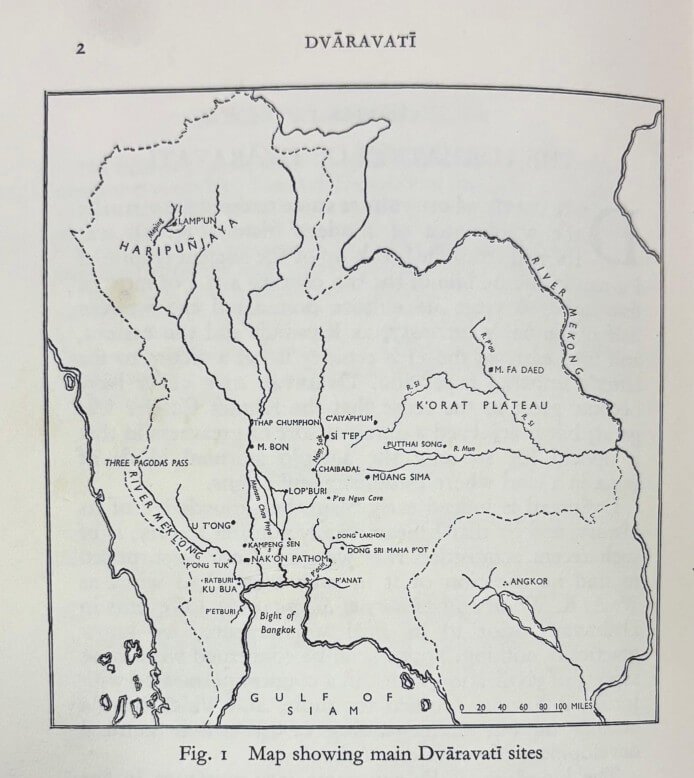
Apart from archival collections, Dvāravatī studies, as a subject, is also present in our printed collections. Our Library holds several publications written by Professor Georges Coedes on this subject, as well as the seminal archaeological survey L’archéologie mône de Dvāravatī by the French archaeologist Pierre Dupont (1870–1954), published posthumously in 1959. These are complemented by other publications in English by Quaritch Wales in our collection, including an author’s copy of Dvāravatī, the Earliest Kingdom of Siam, which is annotated – likely by the author himself – throughout. These publications continue to serve as important textual and visual sources for anyone who is curious about this ancient civilisation.

So, this is just a snapshot of the relevant material in our holdings in association with the upcoming lecture, and I am sure Nicolas Revire’s lecture will provide more insights into this subject than what this short blog post could possibly do. If the above has sparked some interest for you, do come along on 18th September to discover more. As usual, the lecture will be delivered both online and in-person, so you could join us in whichever way is convenient for you. We can’t wait to welcome you back to the Society, either physically or virtually, for more intellectually stimulating conversations!
James Liu