Reminder for Prize Submissions and Coin Catalogues Now Online
We begin this week’s blog post with a reminder to submit to two of the Society’s prizes, both currently accepting nominations.
The first is the Charles H. Norchi Prize, awarded for the publication of a book on Afghanistan written in English. The second is the James J. Busuttil Medal and Prize for Human Rights, awarded for the publication of a book on human rights in English. And just a quick heads-up: a prize presentation ceremony will be held in early December for the 2025 recipients of the Busuttil Medal and Prize. At the event, Dr Sandhya Fuchs, one of this year’s co-winners, will deliver a lecture on her award-winning publication about hate crimes in India. More details of the event will be released soon.
Nominations will close on 31 January for the Norchi Prize, and 31 March 2026 for the Busuttil Medal and Prize. For full details on how to nominate and submit, visit our Awards & Prizes page.
~~~~~
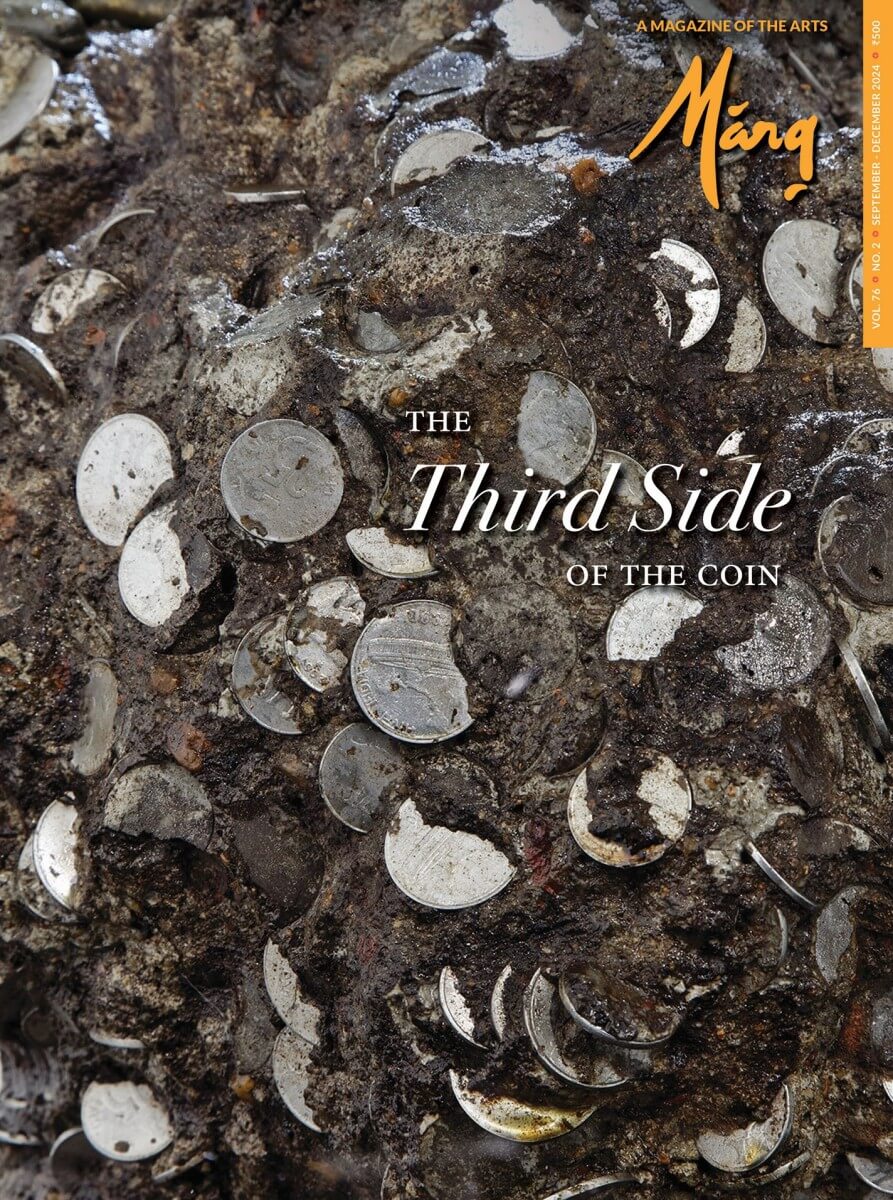
In other news, we have several events coming up in November, including a discussion on The Marg Foundation’s recent volume, The Third Side of the Coin, taking place on Thursday, 13th November. Contributors to the volume, including Joe Cribb, Robert Bracey and Marzbeen Jila, will join moderator Naman P. Ahuja to explore the historical uses of coins beyond their financial function and examine their cultural, artistic and religious significance.
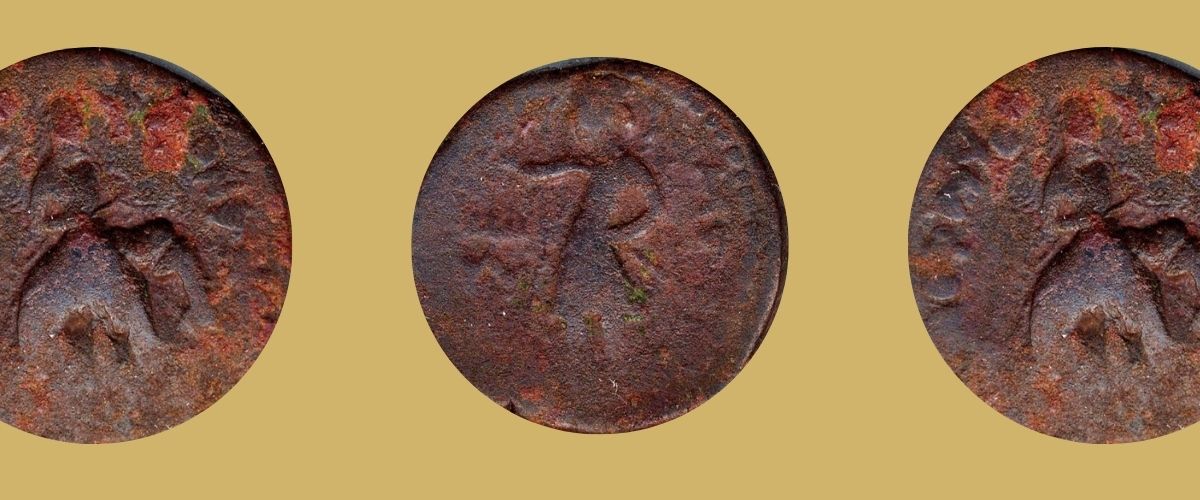
And since we are on the topic of coins, I thought I would take this opportunity to highlight that the catalogue of the Society’s coin collection has recently gone online here. Many of you may not know that the Society holds a small selection of coins within its art collections. Thanks to Dr. M. Nasim Khan, Professor in the Department of Archaeology at the University of Peshawar, who catalogued the collection in 2002, we now have a clearer understanding of when or where these coins were produced and their significance. During the cataloguing process, the coins were also cleaned and conserved, and have since been rehoused in two dedicated cabinets.
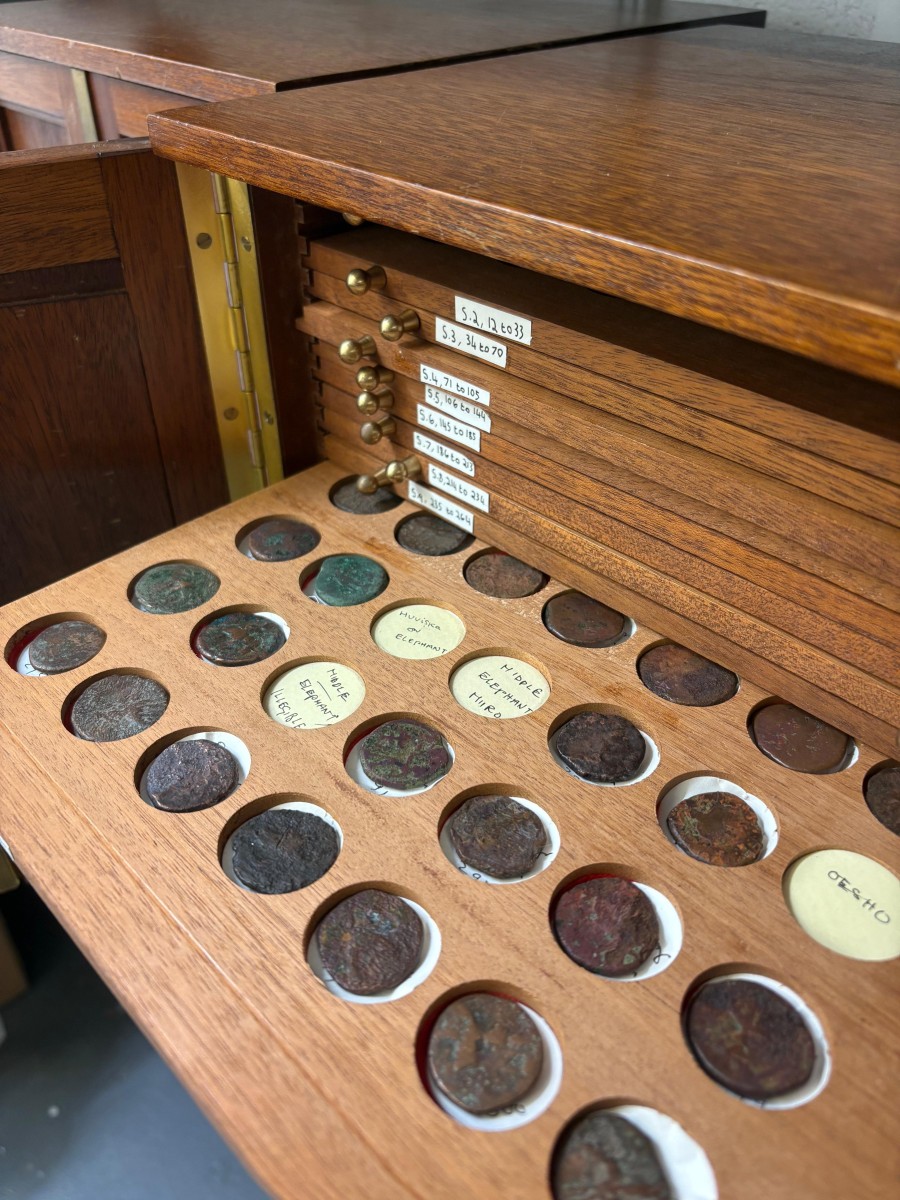
There are some 1,200 coins in the collection, originating from a wide range of geographical regions and historical periods. The earliest specimens from the collection are the ancient Indian punch-marked coins, typically made of copper and dating to the 1st century BC (RAS Coins.09). According to Dr Khan, the most impressive and varied coins of the collection is composed of the Kushan period coins (RAS Coins.01, 02, 03, 04, 05, 06 and 07). The selection almost gives a complete sequence of the Kushan rulers with wide variation in their coin types, especially of Kanishka I (r. 127-150 AD) and Huvishka (r. 150-190 AD). These coins often depict the king in various postures on one side, and mythological and religious figures on the other.
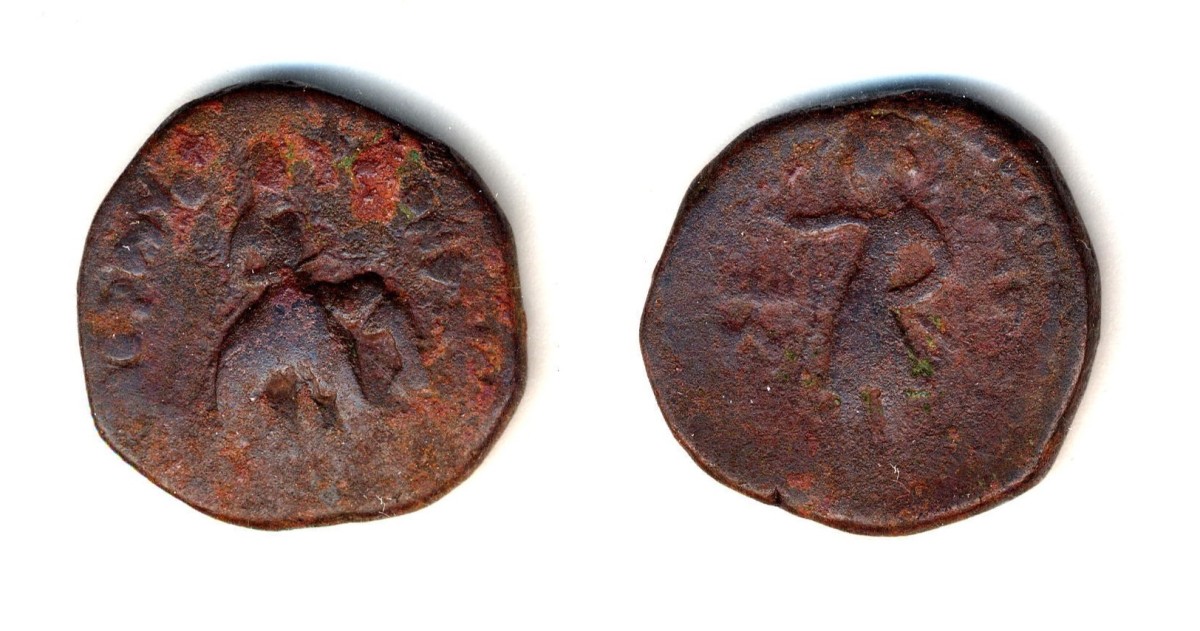
Also added to the online catalogue is a set of 21 coins minted during the Delhi Sultanate, predominantly from the 13th century. These coins were originally part of our Object collection and have been catalogued by Alex from our team recently (RAS Coins.24, 25, 26 and 27).
Establishing the provenance of our coin collection has proven challenging. Although the Society kept a Donations Register in its early years, much of the original coin collection has since dispersed, and the remaining ones do not appear to correspond with the recorded donations. Dr Khan’s research suggests that the Indian punch-marked coins may have been part of James Tod’s bequest to the Society in 1835, while the coherent grouping among the Kushan coins seems to indicate that they belong to one or two archaeological hoards, adding to their potential significance as similar hoards have rarely been recorded before.
For his report, Dr Khan primarily looked at the Society’s acquisition and donations records from the 19th century. To build on this, I thought I would turn to the archival record from the first half of the 20th century in an attempt to trace the documentation and movement of our current coin collection.
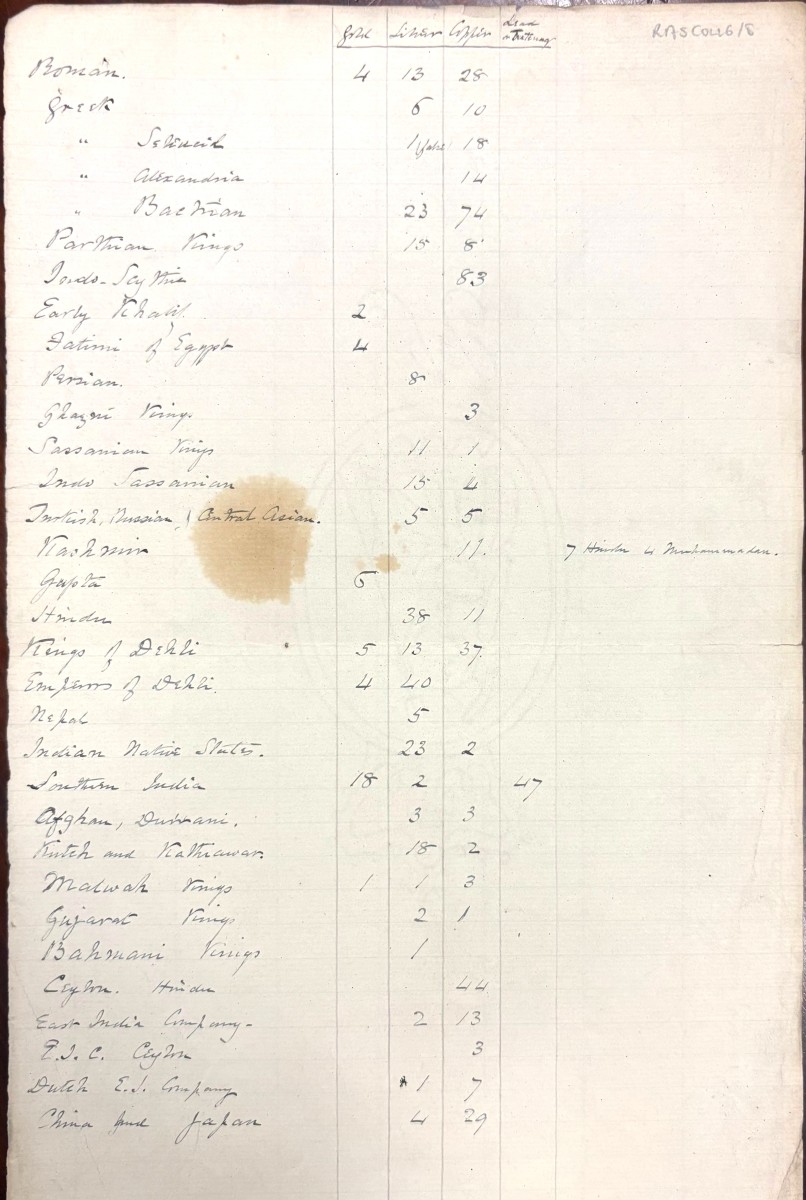
In 1917, a list of coins in the Society’s possession was compiled by the Honorary Librarian Dr Oliver Codrington, himself a numismatic and author of a manual on Islamic numismatics published by the Society. In his report, Dr Codrington recorded a total of 755 coins, comprising 44 gold, 250 silver, 414 copper and 47 lead specimens. They represent an even more diverse geographical range than the Society’s current collection, including examples from Roman, Greek, Persian, Turkish, Indian, Nepalese and Chinese origins, with the largest group being Indo-Scythian coins.
In the following years, at least two sales were made from the Society’s coin collection. One occurred in 1927, when the Council, on 12 April, accepted a committee’s recommendation and decided that the British Museum and the Numismatic Society should be approached as potential buyers. It is unclear to which institution the coins were finally sold, and how many, but subsequent correspondence suggests that Dr Codrington and John Allen, curator in the Department of Coins and Medal at British Museum, were involved in selecting coins for sales.
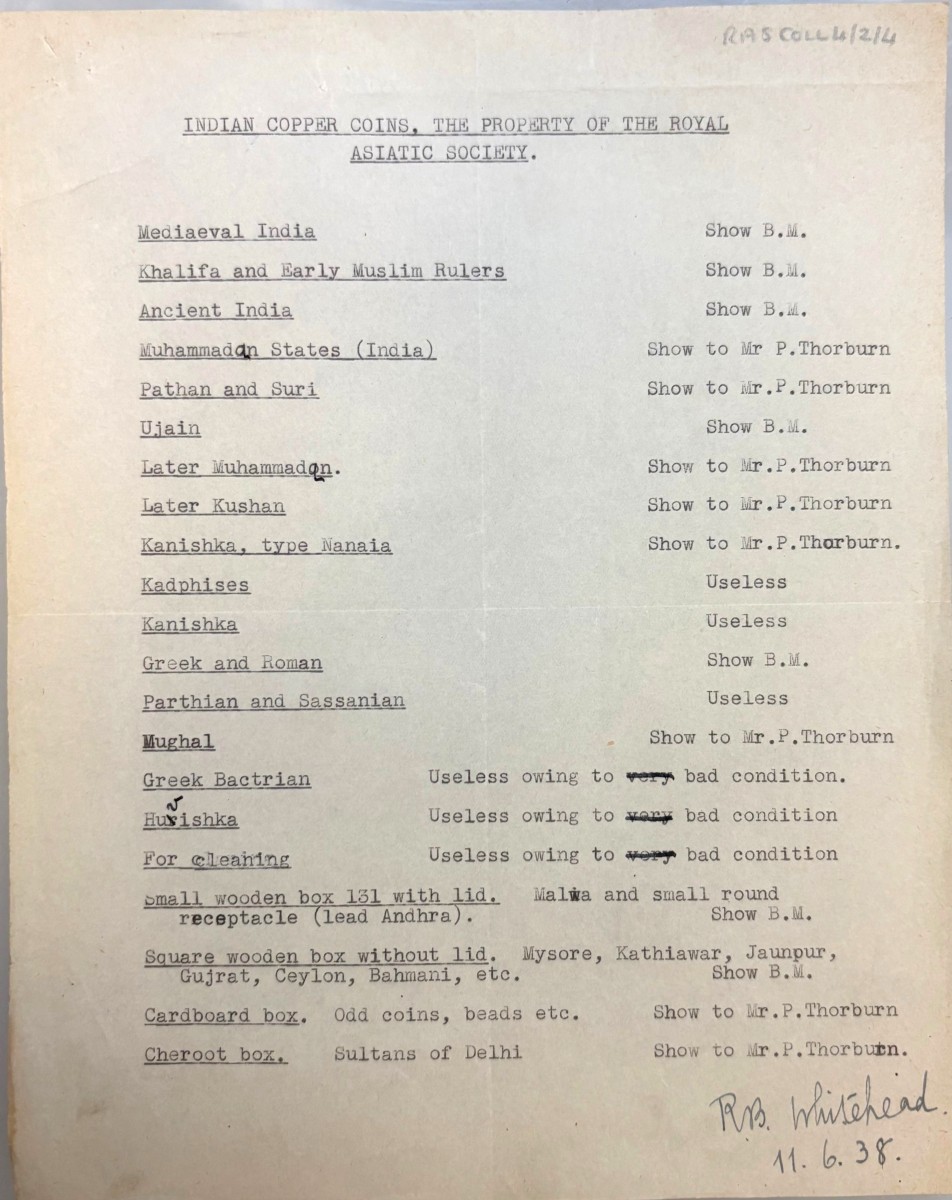
Discussion for another sale happened between 1937 and 1939, prompted by the need to make space for what was described as ‘the great increase of the library of the Society’. Surviving correspondence gives no indication as to the number of coins put up for sale, but it shows that the coins were divided into the following categories:
- Muhammadan States (India)
- Pathan and Suri
- Later Muhammadan
- Later Kushan
- Kanishka, type Nanaia
- Mughal
- Cardboard box. Odd coins, beads, etc.
- Cheroot box. Sultan of Delhi
In October 1939, after considerable negotiation, approximately 60 to 70 coins were sold at £1 each to Sir Richard Burn, a numismatist and member of the Society. An additional 12 Indian coins were sold to a Mr Oldham.
It would appear that the current coin collection is the remainder from the 1927 and 1939 sales, as coins from the Kushan Empire and Sultan of Delhi are mentioned in the correspondence for the second sale. Although the coin collection was not historically regarded by the Council as a major asset of the Society, the responsibility for its care has now fallen on us, and we will work to ensure that the collection is preserved and made accessible for research.
In any case, you can now explore our coin collection and check out the images of each series in our Library catalogue. We hope this will help enhance the discoverability of our coin collection, and perhaps renew the research interest in these tiny little treasures. If you are interested in finding out more about our coin collection, please don’t hesitate to get in touch. Or, if you are simply curious about the many ways coins have been used beyond transactions, you are most welcome to join us for the discussion on 13th November to explore further!
James Liu