Remembering Raymond Head (1948–2025)
Friends of the Society may be aware that our member, Raymond Head, sadly passed away last month at the age of 77. Raymond first joined the Society in 1977 and was associated with the Society mainly through his monumental undertaking of creating a catalogue for its art collections, which was published in 1991. More than three decades later, his catalogue remains an invaluable resource, serving as a vital reference tool for staff and researchers exploring the Society’s remarkably diverse art holdings.
Below, we share two heartfelt tributes to Raymond – one from Andrew Topsfield, Honorary Curator of the Ashmolean Museum, and another from our Council member, Rosie Llewellyn-Jones, as well as a few lines on his papers in our collections.
—
Tribute from Andrew Topsfield:
Raymond Head, who died on 1 September, was a familiar figure at the Society’s former Queen Anne Street home in the late 1970s and ’80s. As his mentor Mildred Archer had done at the India Office Library in the 1950s, he went meticulously through every cupboard, listing and describing the rich collections of European and Asian works of art acquired by the Society over the previous century and a half. His Catalogue of Paintings, Drawings, Engravings and Busts (1991) has been a valuable resource for scholars and curators ever since.
Ray’s main vocation was as a musician, composer, conductor, teacher and musicologist. But as a student at Dartington College of Arts in the late 1960s, he also developed an abiding interest in India and its culture. Rabindranath Tagore had been an early associate of the College, and musicians such as Ravi Shankar and Imrat Khan taught or performed there. Much of Ray’s later writing was devoted to the study of Indian influences on British composers such as Gustav Holst and John Foulds. His research interests extended moreover to Indian influences on Western architecture, and his book The Indian Style (1986) presented a wide-ranging account of the subject, from Sezincote House to American cinemas built in fantastical ‘Hindu’ styles.
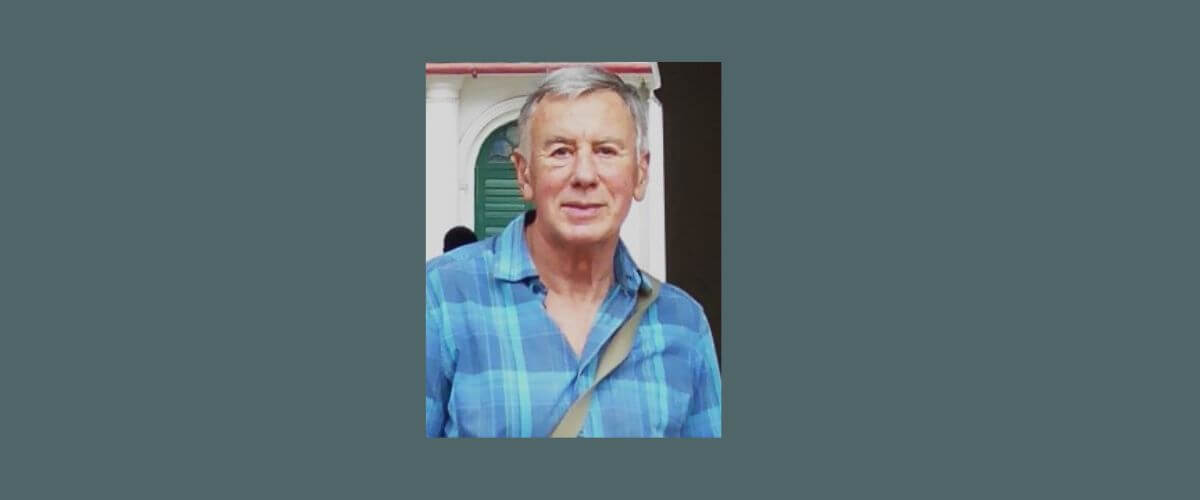
Ray visited India only once, late in life, with his wife Anthea. His photo shown here [above] was taken at the Tagore family house in Calcutta.
—
Tribute from Rosie Llewellyn-Jones:
As a young man Raymond Head lodged in north London with Mildred and William Archer, the curators and collectors of Company School paintings and this undoubtedly sparked his interest in the visual arts of the subcontinent. During the early 1980s, Ray and I worked together on a short-lived Indian-funded cultural magazine, ‘Koh-i-noor’ produced in London.
At the same time he was researching his book on ‘The Indian Style’ which is still the best analysis of the influence that India had, and continued to exert, on architecture and design in Britain and Europe. This was not just confined to obvious places like Brighton Pavilion, Daylesford and Sezincote, but took the argument to early 20th century theatres, opera houses and cinemas, including the Granada at Tooting, which all incorporated ‘oriental’ themes.
Ray was fascinated by the cross-over between 18th century Indian music, appreciated by a very small number of Europeans like Elizabeth Plowden, but written evidence was limited on this subject.
His relationship with the RAS was not always smooth and he resigned his membership over the initial non-publication of his catalogue of the Society’s paintings and drawings. Happily, he later rejoined the Society at my suggestion and it was Ray’s incentive that saw the Journal abandon the use of plastic envelopes for postage to the more environmental-friendly paper envelopes.
Ray had had a minor stroke about ten years ago, but he courageously overcame this and made a point of travelling frequently into Oxford where he could be found sitting happily in Blackwells bookshop and cafe in Broad Street.
He leaves behind him his widow Anthea, and an only daughter, Susannah.
—
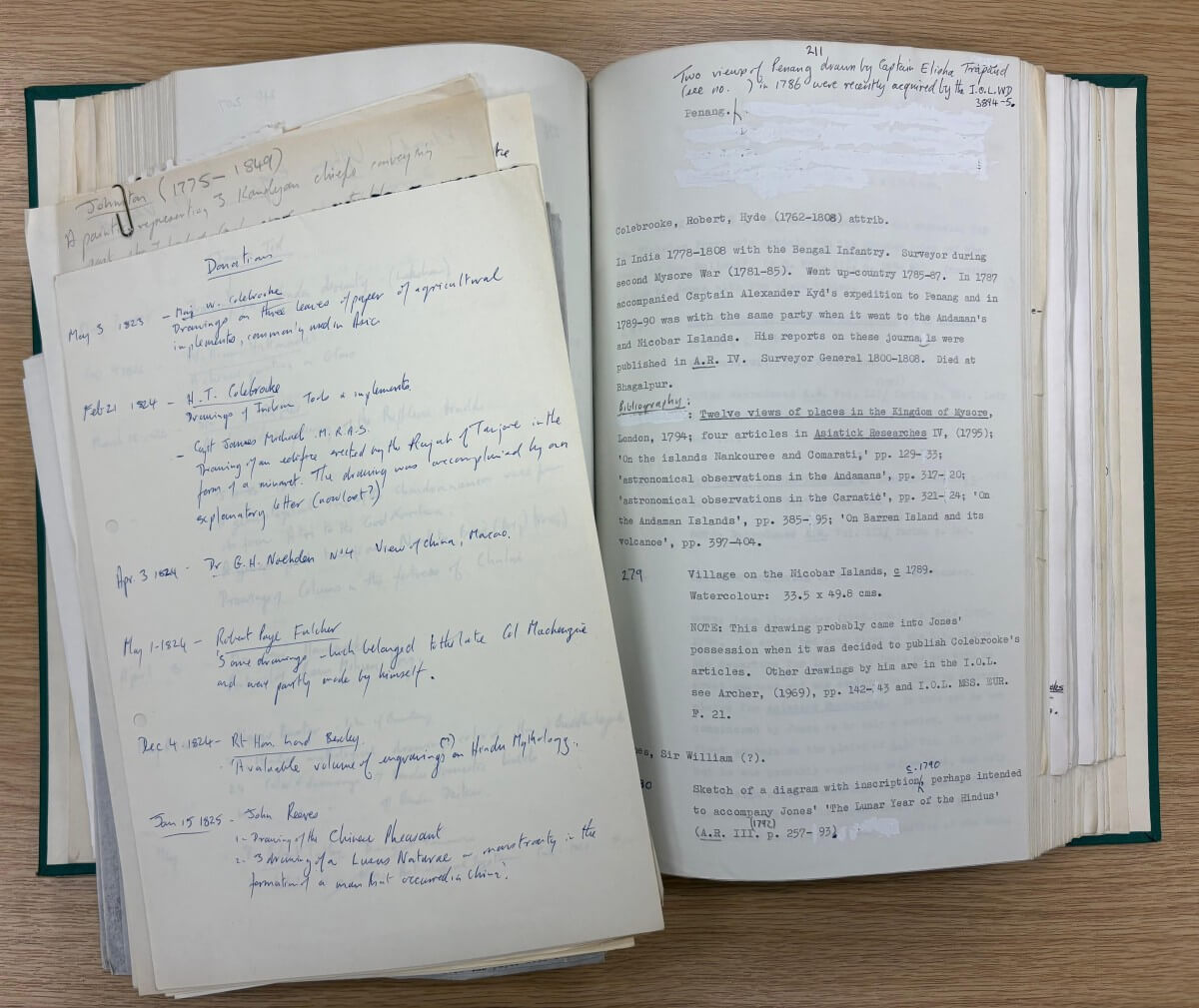
The Society also holds a small collection of papers belonging to Raymond, all pertaining to the compilation of the catalogue. The material includes a manuscript proof, correspondence connected to the artworks of the Society, as well as notes and articles which Raymond collected and collated during his research. These are catalogued in our Archive catalogue here.
The papers offer a glimpse into what must have been a painstaking, lengthy and complex process of compilation – surveying, listing, researching, arranging and describing the artworks. In Raymond’s own words, he began cataloguing the Society’s art collections in the late 1970s, when ‘the pictures were scattered all over the building at 56 Queen Anne Street, London, W. 1. (then the society’s home) and I collected pictures, drawings and sculpture from all over the building and re-assembled them’. The correspondence in the papers also reveals that as early as 1981, Raymond was in touch with researchers and curators from other institutions to investigate individual artworks, identify their artists and find out more about the individuals who donated them. His handwritten notes further suggest that he consulted a lot of archival sources to trace the provenance of the works.
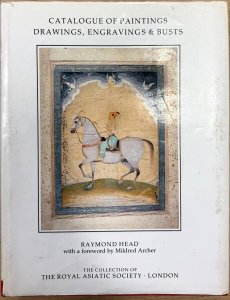
So, the catalogue – spanning 229 pages and listing over 1,800 works – that we continue to consult today is the culmination of more than a decade of effort. It is a testament to Raymond’s dedication, attention to detail and, above all, his deep passion for the visual arts. We can’t thank Raymond more for his contributions to the Society and we would like to send our heartfelt condolences to his family and friends at this very sad time.
James Liu