September Events
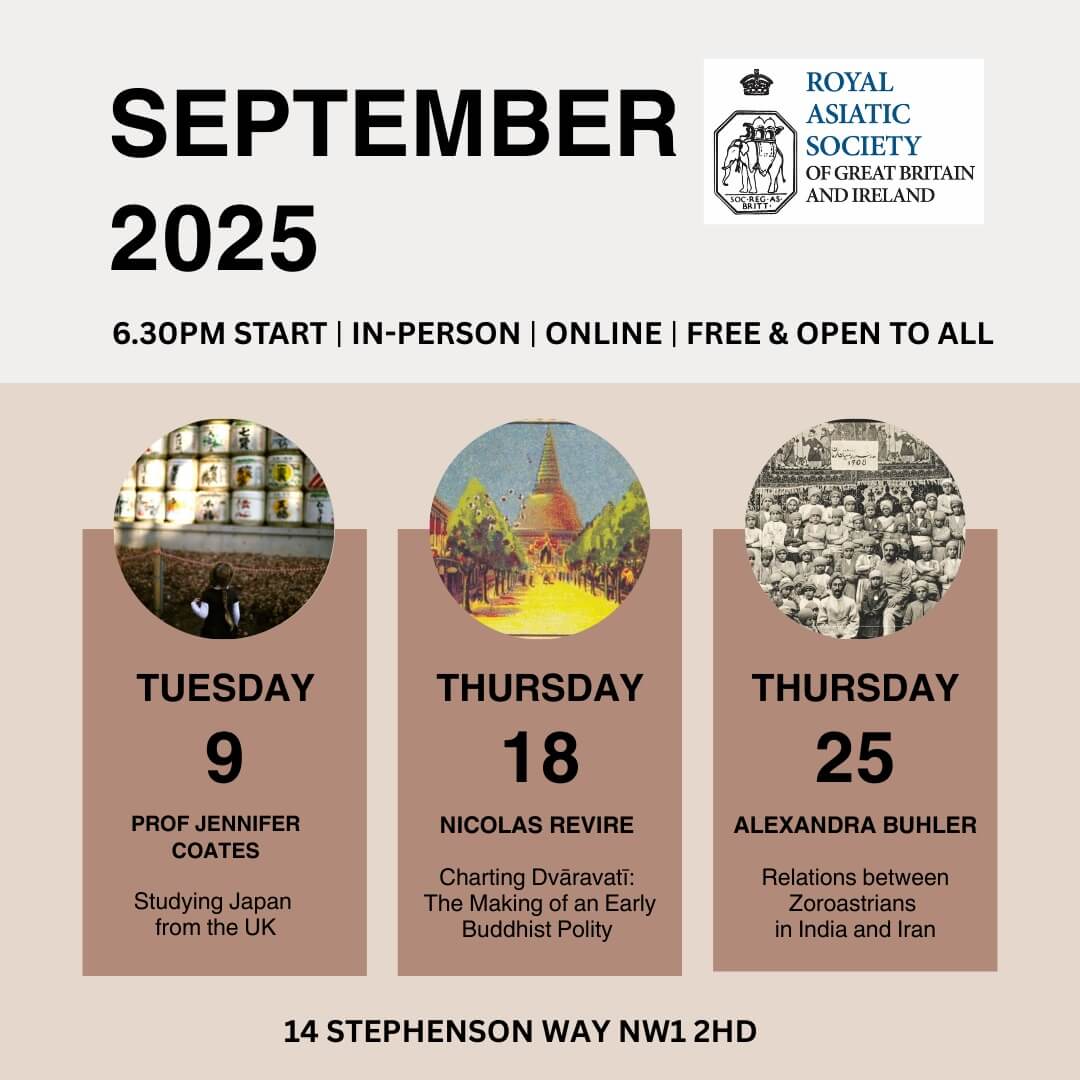
To join online please email Matty Bradley at mb@royalasiaticsociety.org
Professor Jennifer Coates
Studying Japan from the UK: New Challenges and Historical Precedents
Part of the series: Japanese Studies: Past, Present and Future
Tuesday 9th September at 6.30pm
This talk reflects on the past, present and future of Japanese Studies in the UK; the antecedents of the field, its strengths and challenges, and its place in our fast-changing globalised world. As many countries turn inwards to prioritise national concerns and domestic politics, Japan remains an object of fascination for students, researchers, and the general public. From the mystical ‘Japan’ located just west of Laputa in Jonathan Swift’s Gulliver’s Travels (1726) to the ‘Japan’ of geisha in rickshaws captured by the Lumière brothers’ cameramen (1897), and from the opponents of World War II to the exciting exoticism of ‘Japan’ as holiday destination, our engagement with ideas about ‘Japan’ has shaped not only the UK understanding, but also the UK itself. Connecting the history of the study of Japan to contemporary research on its impact on the UK, this talk demonstrates the value of learning about Japan.
Jennifer Coates is Professor of Japanese Studies at the School of East Asian Studies, University of Sheffield and President of the British Association for Japanese Studies. Her books include Making Icons: Repetition and the Female Image in Japanese Cinema, 1945-1964 (2016), Film Viewing in Postwar Japan, 1945-1968: An Ethnographic Study (2022), and co-edited volumes War Memory and East Asian Conflicts, 1930–1945, Japanese Visual Media: Politicizing the Screen and The Routledge Companion to Gender and Japanese Culture.
Nicolas Revire
Charting Dvāravatī: The Making of an Early Buddhist Polity In Central Thailand
Thursday 18th September at 6.30pm
This lecture explores the intellectual foundations of Dvāravatī studies and the making of an early Buddhist polity in central Thailand during the mid-to-late first millennium CE. It highlights the pivotal roles of Prince Damrong Rajanubhab (1862–1943) and Professor George Cœdès (1886–1969), whose historical and epigraphic work shaped modern understandings of Dvāravatī as a Theravāda Buddhist culture with Old Mon, Sanskrit, and Pali influences. Beginning with the 19th-century rediscovery of sites like Nakhon Pathom, the talk traces how their scholarship framed Dvāravatī in both historical, and cultural terms. It also considers the legacy of their work in the writings of later scholars and Orientalists such as Horace Geoffrey Quaritch Wales (1900–1981), Pierre Dupont (1908–1955), Jean Boisselier (1912–1996), or Piriya Krairiksh (b. 1942), whose contributions continue to shape debates on early Southeast Asian religion, language, and state formation.
Born in France, Nicolas Revire holds a doctoral degree from Paris, specializing in Hindu-Buddhist art of early Southeast Asia, particularly pre-modern Thailand. As a senior research fellow at the Art Institute of Chicago, he brings expertise from two decades of teaching and research in Bangkok. The speaker has published extensively on the subject and is currently the managing editor of the Journal of the Siam Society.
Alexandra Buhler
Relations between Zoroastrians in India and Iran: the role of the British and the impact of the ‘Great Game’
Thursday 25th September at 6.30pm
This talk will draw on the research I conducted for my recent book, Zoroastrianism in India and Iran: Persians, Parsis and the Flowering of Political Identity, which examines the cultural, religious, and political ties between the Zoroastrian communities of Iran and India during the late Qajar and early Pahlavi periods. In particular, I will focus on the role played by the British in encouraging strong relations between the two Zoroastrian communities and on the geo-political factors that motivated them to do so.
Towards the end of the nineteenth century, the rivalry between Britain and Russia over Iran led the British to attempt to utilise their positive relations with the Parsis, Zoroastrians in India, to establish strategic ties with Zoroastrians in Iran. Additionally, the British supported efforts being made by Parsis to reconnect with their co-religionists and with their ancient homeland.
Diplomatic relations between Britain and Russia underwent a significant development with the signing of the Anglo-Russian Convention in August 1907. I will assess the extent to which the tripartite relations between the British, Zoroastrians in Iran, and Parsis were affected by the convention in the following months and years.