October Events
To join any of these events online please email Matty Bradley at mb@royalasiaticsociety.org with the name of the event in your subject heading.
For all upcoming lectures click here.
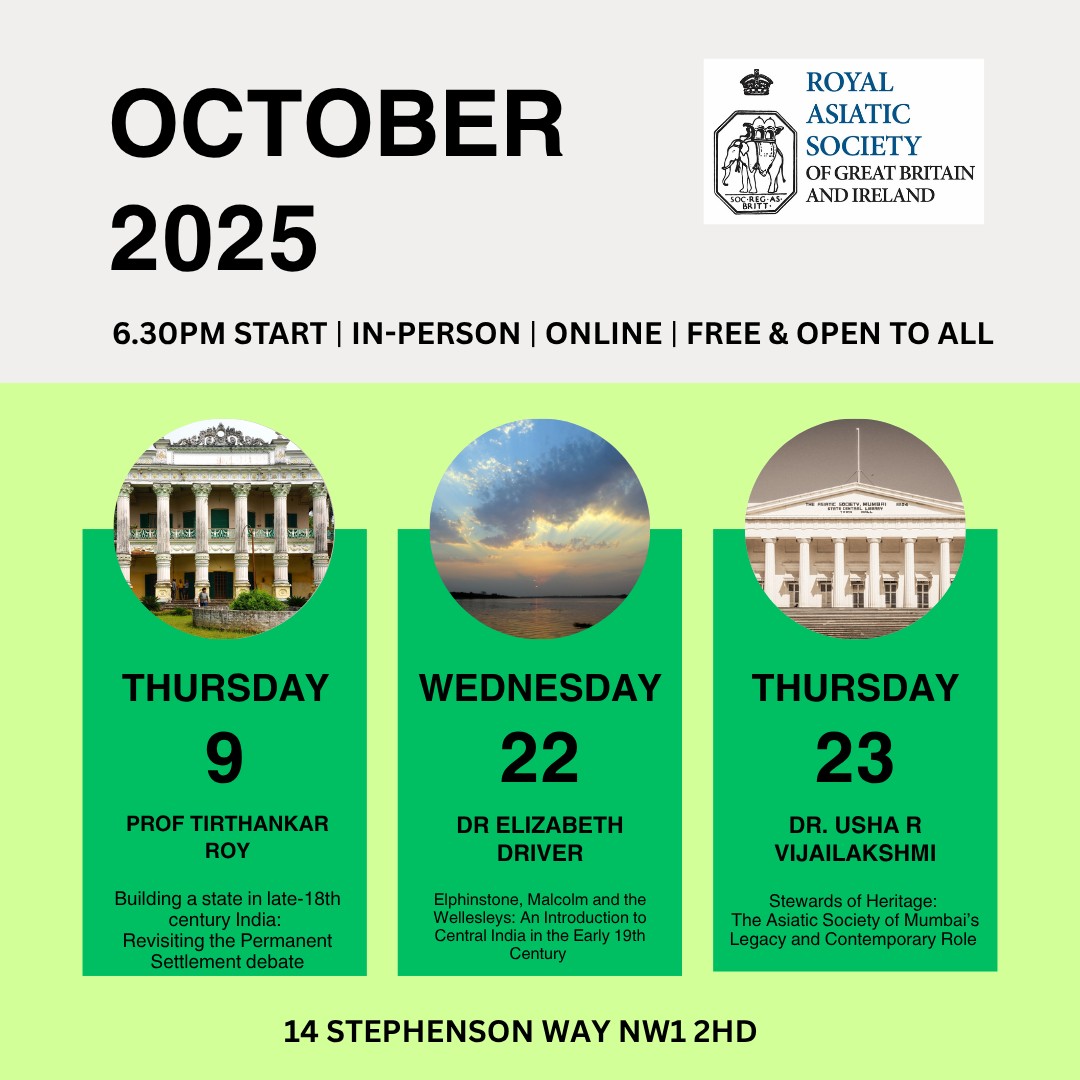
Prof Tirthankar Roy
Building a state in late-18th century India: Revisiting the Permanent Settlement debate
Thursday 9th October at 6.30pm
“The principle on which [Akbar] secured his conquest was [to show regard] to the right of the Zemindars, the ancient proprietors of the soil,” said Philip Francis in 1777. Disagreeing radically, his rival and critic Warren Hastings said that “much the greatest part of the Zemindars… are incapable of judging or acting for themselves, being either minors, or men of weak understandings, or absolute idiots.”
Two statesmen in charge of building a state in Bengal made these conflicting comments about the zamindar, a magnate in the countryside. Their debate reveals the complicated nature of the statebuilding project in Bengal at that time, with limited trust in indigenous institutions and intermediaries and yet limited power to supersede these. The talk will discuss this debate and suggest how we should read institutional reforms in early-colonial India.
Dr Liz Driver
Elphinstone, Malcolm and the Wellesleys: An Introduction to Central India in the Early 19th Century
Wednesday 22nd October at 6.30pm
The first decades of the 19th century have been described as the “golden age of English rule” “a brief but glorious interregnum between eighteenth century corruption and nineteenth century complacency”. This was the age of Elphinstone and Malcolm in Central India and Bombay, Tod in Rajputana and Munro in Madras. All were Scots, with the impressive ability to combine military, political and diplomatic roles with literary and linguistic skills. All worked hard to restore order and prosperity in the aftermath of the Anglo-Maratha and Pindari wars and believed that there should not be excessive interference by the now paramount power in the running of the native states and in their judicial systems. They were opposed to colonisation and to attempts to convert to Christianity and, above all, believed that Indians should be educated to govern their own country when the English left, as they should and inevitably would. Their views on the need for education and the role of the state in funding it were at least a decade ahead of the government at home, where it was only just being recognised that the state had a duty to see that its citizens could read and write.
Inevitably, the accusation of orientalism has been made against them and it is argued that their interpretation of Indian culture and history was distorted by their Scottish enlightenment “cultural luggage”. This talk looks at the achievements–and failures-of Elphinstone and Malcolm in Central India following the expansion of East India Company territory under Governor-General Richard Wellesley and the military successes of his brother Arthur, the future Duke of Wellington. It examines the characters of the men and the influence that had on the way they fulfilled their various roles, including, in both cases, that of Governor of Bombay.
Prof. Usha Vijailakshmi
Stewards of Heritage: The Asiatic Society of Mumbai’s Legacy and Contemporary Role
Thursday 23rd October at 6.30pm
Founded in 1804 by James Mackintosh, the Asiatic Society of Mumbai was envisioned as both a research body and a library, dedicated to advancing knowledge of the East in fields ranging from Sanskrit studies and history to geology, botany, and medicine. At a time when Bombay lacked institutions of higher learning, the Society became a hub of intellectual exchange, sustained by British administrators, Indian scholars, and local patrons. Over two centuries, it has amassed a vast collection of manuscripts, coins, inscriptions, and rare books, while also shaping public intellectual life through lectures and publications.
Yet today, the Society faces pressing challenges: financial constraints, administrative pressures, and the delicate balance of autonomy with state obligations. Despite these hurdles, it continues to catalogue, conserve, and engage the public, striving to uphold its relevance in a rapidly changing academic and cultural landscape. This talk examines the Society’s enduring significance and the formidable challenges it faces in sustaining its legacy.
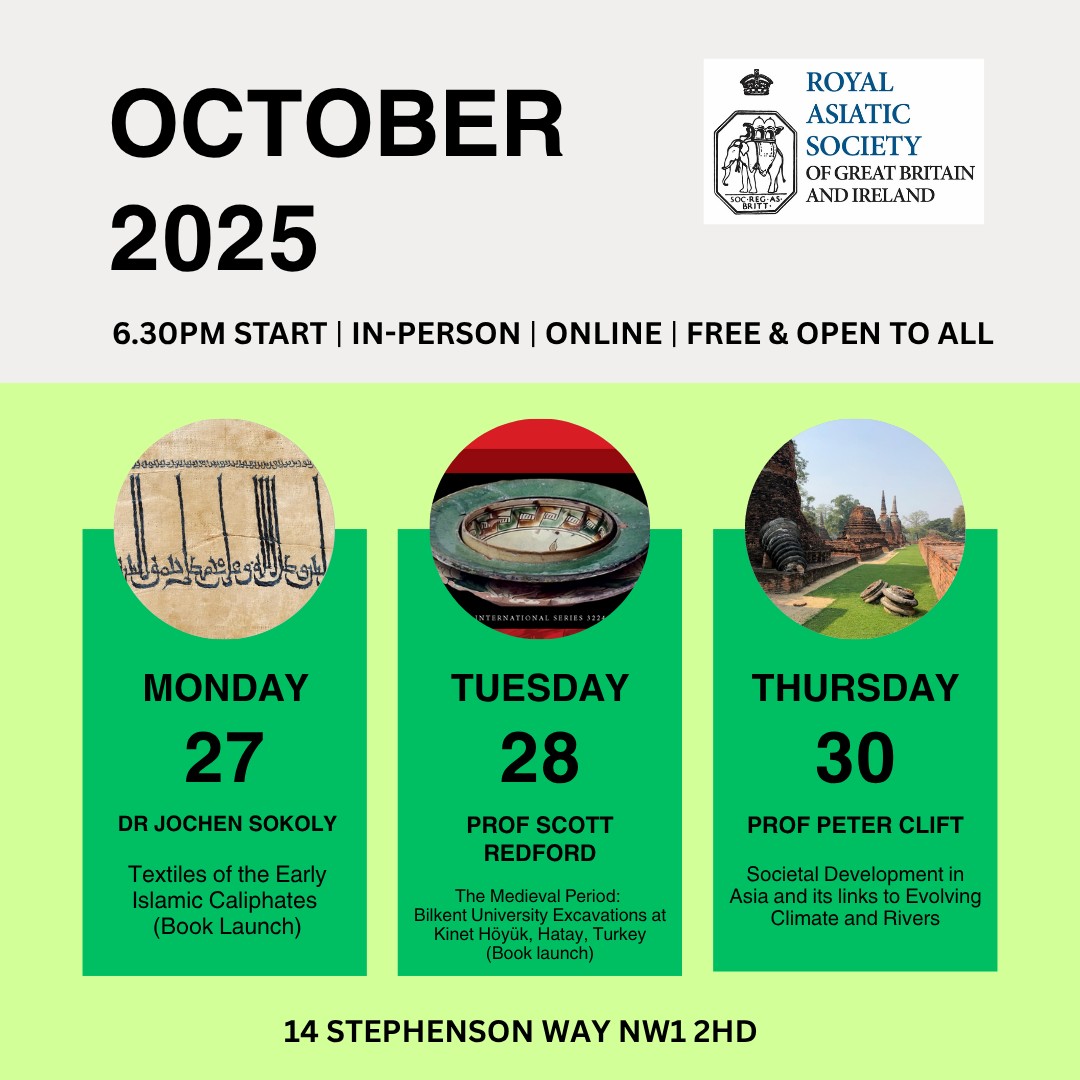
Dr Jochen Sokoly
Textiles of the Early Islamic Caliphates (Book Launch)
Monday 27th October at 6.30pm
Featuring more than 180 textiles from The al-Sabah Collection, some never published before, this volume provides authoritative analysis not only of the textiles themselves, but also of the historical and cultural context in which they were produced. With hundreds of illustrations, including specially commissioned macrophotography, Textiles of the Early Islamic Caliphates is a landmark publication that will appeal to scholars and general readers alike.
Tiraz textiles were highly valued in the early Islamic world. Inscribed with sacred invocations and the name of the ruling caliph, together with the names of administrators, the type of workshop in which the textile was made, the workshop’s location and the year of manufacture, these textiles provide an invaluable window into the political, administrative and religious life of early Islam, as well as various traditions of textile production. Other textiles of the period, similar in style but uninscribed, were decorated with colourful medallions, depicting animals and other motifs. The large majority of the surviving fragments of tiraz textiles, which were originally given as robes of honour to courtiers and ambassadors, have been found in Egyptian tombs: most of the textiles examined in this book once belonged to burial outfits from the diverse religious communities in Egypt during the early Islamic period.
Jochen Sokoly is Professor of Art History of the Islamic World at Virginia Commonwealth University School of the Arts in Qatar. His research focuses on the material culture of the Early Islamic caliphates, particularly the context of court, administration and manufacture. He has published on early Islamic inscribed textiles, served as co-chair of the Hamad bin Khalifa Symposium, and curated exhibitions on contemporary Middle Eastern art. Sokoly has held fellowships at AKPIA Harvard, the Metropolitan Museum of Art, New York and the Royal Ontario Museum, Toronto, and has served as a member of Council of the Royal Asiatic Society, London. He received his DPhil from the University of Oxford and holds degrees from the School of Oriental and African Studies, London.
Prof Scott Redford
The Medieval Period: Bilkent University Excavations at Kinet Höyük, Hatay, Turkey
Tuesday 28th October at 6.30pm
This study, focusing on the Rum Seljuk dynasty in thirteenth-century Anatolia, combines local history, geography, art history, and archaeology to examine instances of an only partially understood garden tradition in one corner of the medieval Mediterranean. Gardens, and their architecture, have been neglected, not only because of the paucity of remains, the architecture they inspired was not monumental and relied strongly on a sense of place, and a sensitivity to the landscape. This book attempts to recover a measure of that sense and that landscape, as well as the activities that endowed them with meaning for those that enjoyed them.
Prof Peter Clift
Societal Development in Asia and its links to Evolving Climate and Rivers
Thursday 30th October at 6.30pm
The strength of the Asian monsoon has varied over timescales spanning millions to thousands of years and even decades. Climate records stored in lakes, caves and marine sediments now allow its reconstruction with unprecedented precision. Since around 10,000 years ago changes in monsoon intensity have impacted the development and then demise of civilisations across Asia especially those located on the edge of the monsoon system. The Indus Valley Civilization is a good example of a culture that developed when the monsoon was stronger, then responded to the slowly drying climate before eventually dissipating, leading to the abandonment of their cities. It is largely through agriculture that the monsoon control is recognised. Other examples of societal crises brought on by climate change include Angkor Wat but also the Ming and Song dynasties in China. Strong monsoons appear to have allowed the Mongol conquest of Eurasia in the 13th century. Future warming of the climate is expected to result in stronger monsoons but also more stormy conditions which are also not connected to productive agriculture. Some areas like northern China are predicted to become drier. The monsoons furthermore fuel the large rivers of Asia which have been critical to the development of major urban centres across the continent in the historical and prehistorical past. Climate changes also affecting the track of typhoons in the Western Pacific with fewer going into the South China Sea and towards Vietnam and more moving to the north-east towards central China and Japan. The future prosperity of Asia is also threatened by rising sea levels, particularly in southeast Asia and eastern China. Understanding how people adjusted to claim a change in the historical and archaeological past is important for developing effective strategies for dealing with current and future changes.
Peter Clift has been a professor in the Department of Earth sciences at University College London since 2023. He previously worked at a variety of institutes in the US and the UK and has been a sabbatical or visiting researcher in India and China. He has been a visiting professor at the Chinese Academy of Sciences, South China Sea Institute for Oceanology for 20 years. Clift did his BA at the University of Oxford and a PhD at the University of Edinburgh. He is most well known for his work on the origin and development of the Asian monsoon and has used sediments preserved in the seas around Asia to look at the evolution of landscape with the impact of climate change and human settlement being of particular focus. He has a special interest in the Indus Valley Civilisation and the interactions of the Indus river and Thar Desert system with the human history of South Asia. Clift is a fellow of the American Geophysical Union as well as the Geological Society of America and in 2023 he was awarded the Lyell medal by the Geological Society of London. In 2024 he was Jubilee Chair Professor at the Indian Academy of Sciences and this year holds a Chinese Academy of Science President’s International Fellowship.