
Early-19th-Century Chinese Magazine and Gulistan of Sa’di in Hong Kong
I feel like the blog has become a space for me to share my spontaneous discoveries in the Library (which I very much enjoy!). Having grown up in Hong Kong, I have a natural predilection for East Asian history. As a result, I am always on the hunt for relevant materials in our collections, particularly those in Chinese and Japanese. So, following the two copies of an early printed Chinese book on rice farming and silk production which I blogged about a couple of weeks ago here, another recent discovery—pictured below—is several thread-bound Chinese books. These books must have been sitting on a side table in our repository for quite some time, and if it hadn’t been for some pages with Chinese characters sticking out from the pile, I wouldn’t have noticed them.
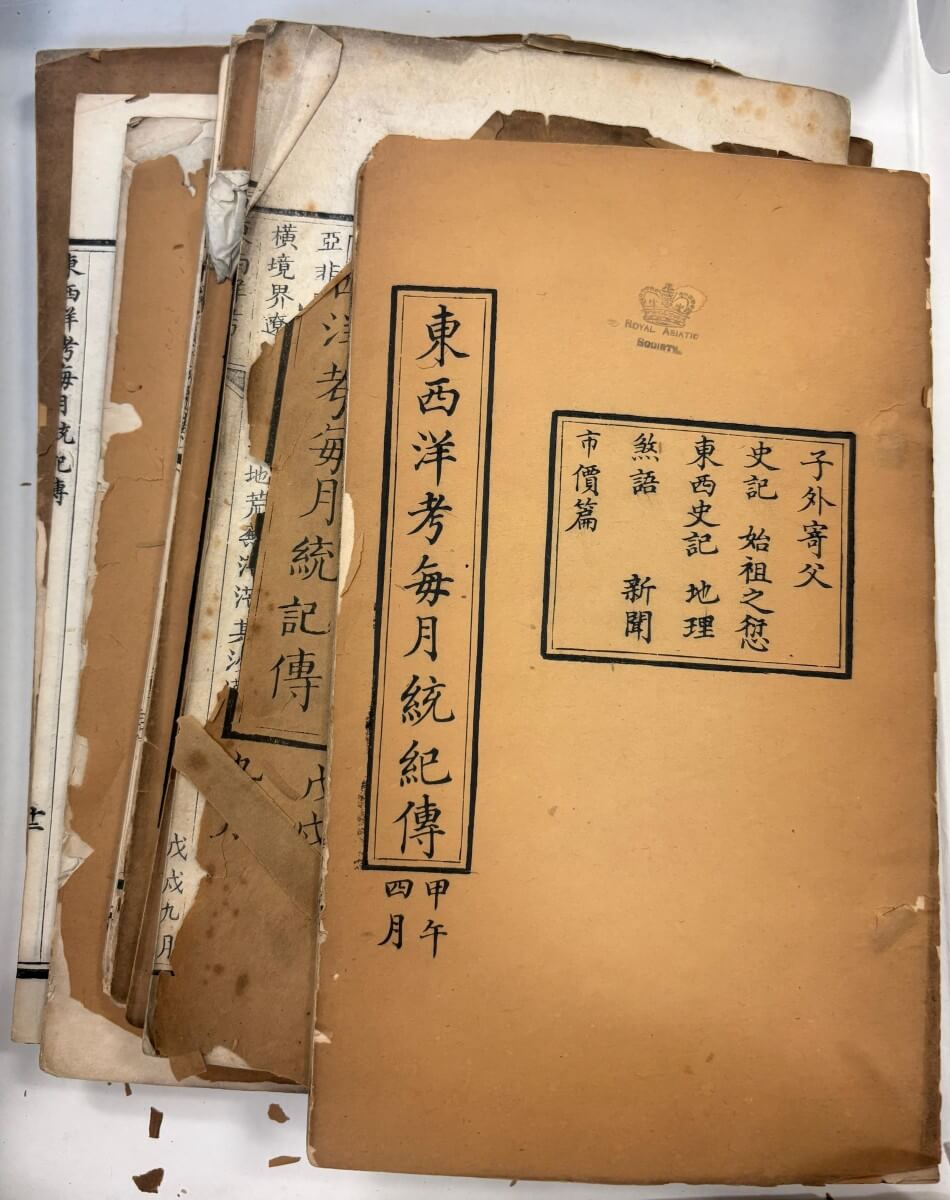
These are copies of the Eastern Western Monthly Magazine (東西洋考每月統記傳), the earliest periodical printed in the Chinese language in China. Published between August 1833 to October 1838, during the reign of the Daoguang Emperor, this monthly publication was compiled by the German missionary Karl Gützlaff (1803–1851), who served across Asia for over two decades. Among many Asian countries where he worked, Gützlaff left a significant legacy in China, where he was actively involved in missionary translation and publishing projects.
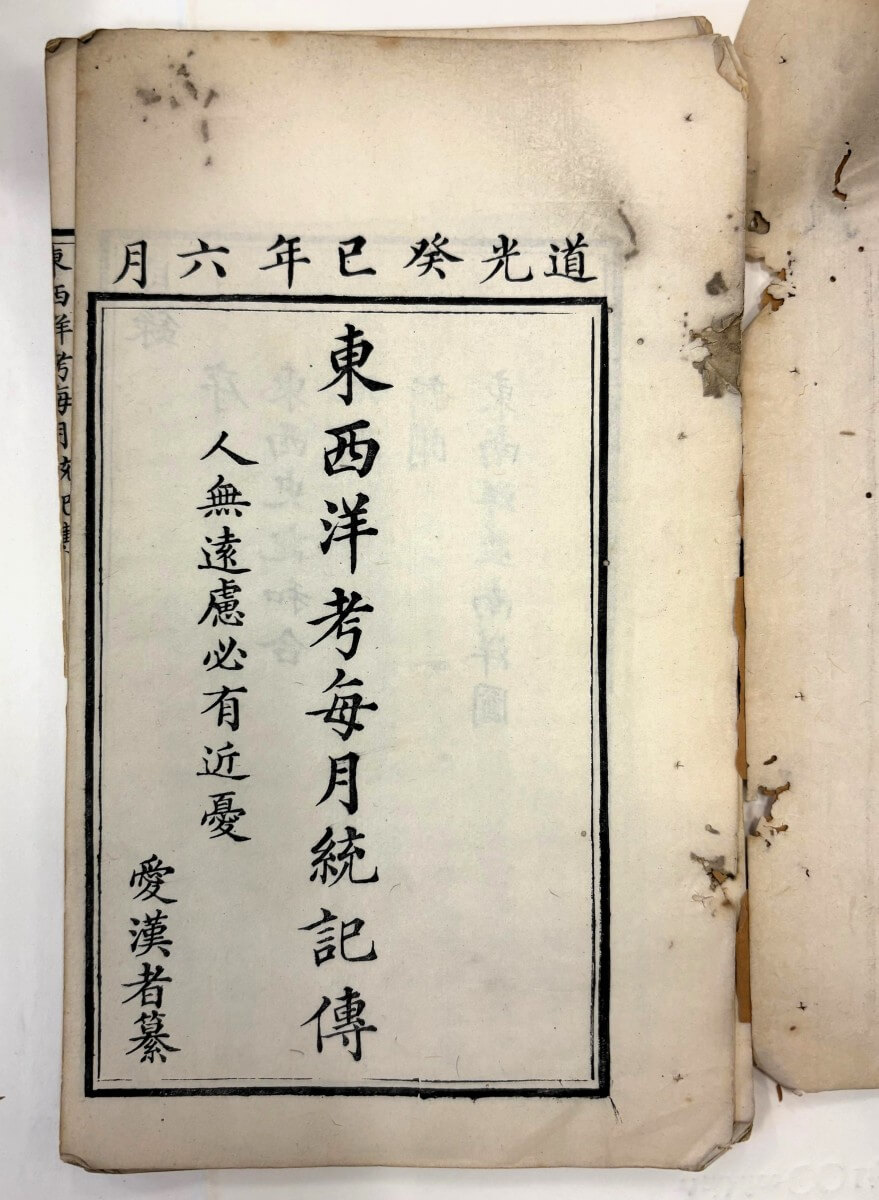
This magazine was one such endeavour. In the preface of the inaugural issue, Gützlaff wrote how he embraced the Confucian teaching that ‘within the Four Seas, everyone else is a brother’, and hoped this publication would help promote harmony between China and foreign nations. Possibly an attempt to obscure his evangelical background, Gützlaff published using his pseudonym 愛漢者, which literally means ‘one who loves the Chinese’. Gützlaff was, conceivably, not without a religious agenda, as fostering a more sympathetic attitude towards the West among the Chinese could have advanced his missionary work. However, this does not diminish the magazine’s merit of introducing Western knowledge into the literate circle of China.
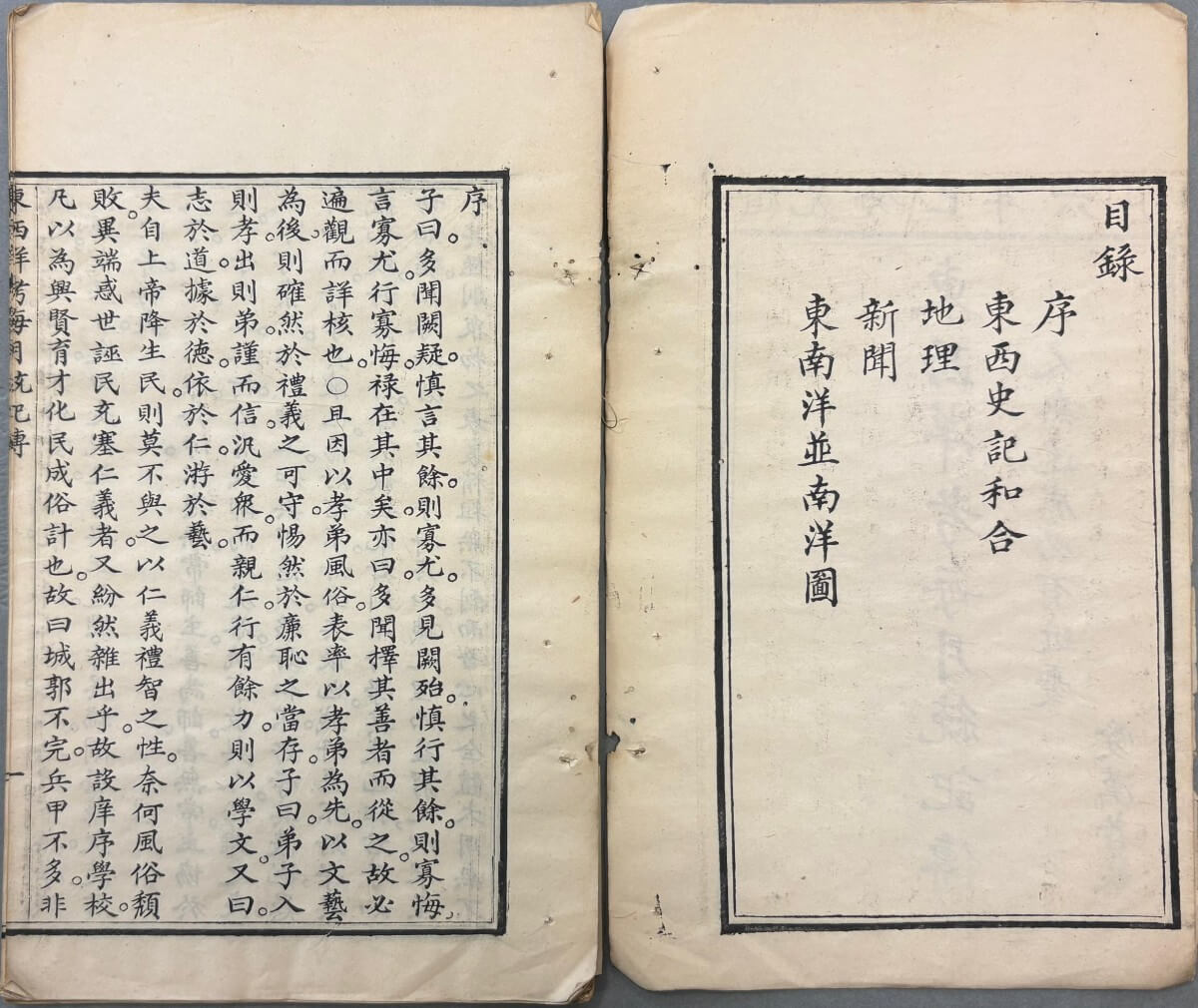
Following the preface, the inaugural issue opens with a section on Chinese and Western history, in which Gützlaff tried to draw a parallel between the two civilisations by tracing their origins to a ‘great flood’. This is followed by a section entitled ‘Geography’, which gives an overview of the geography and topography of China’s southeast coast and Southeast Asia. Next comes a ‘News’ section, offering brief updates on the ‘national affairs’ of Turkey and the Netherlands. This issue concludes with a fold-out coloured map of Southeast Asia, depicting the Malay Archipelago with annotations of the islands.
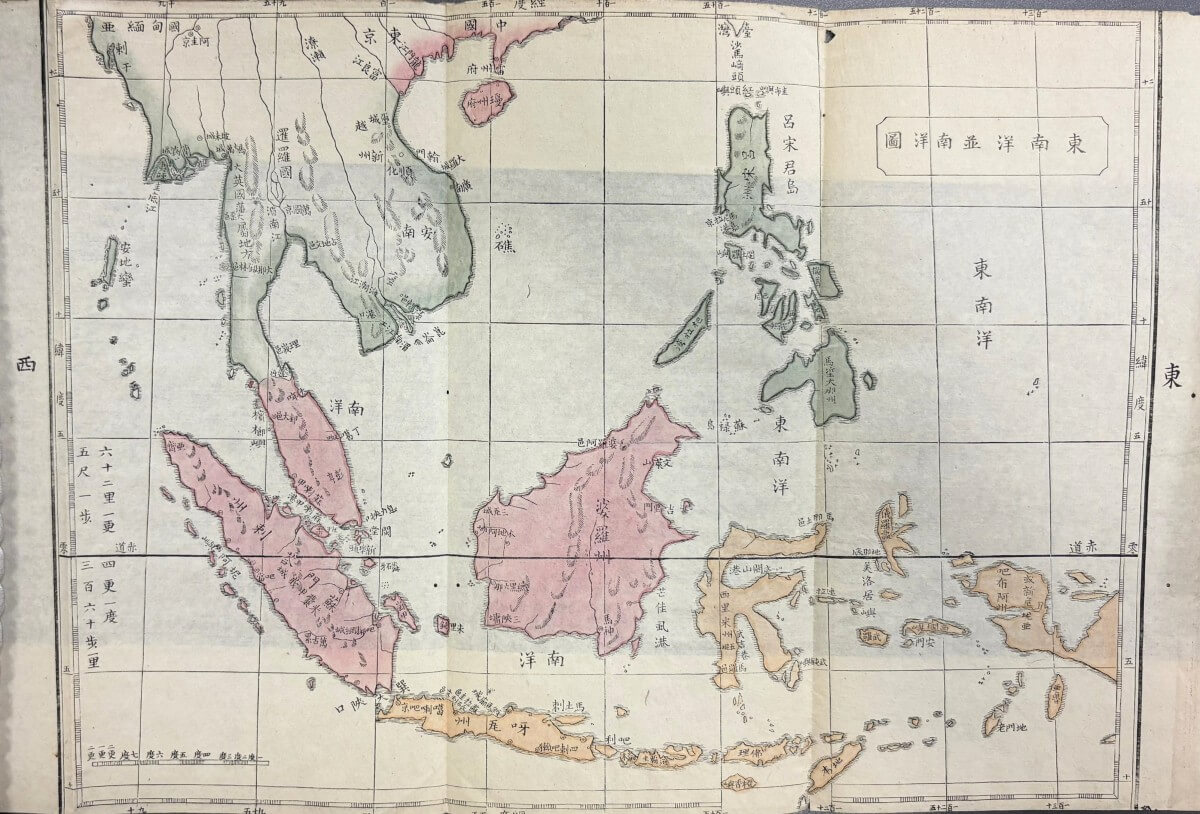
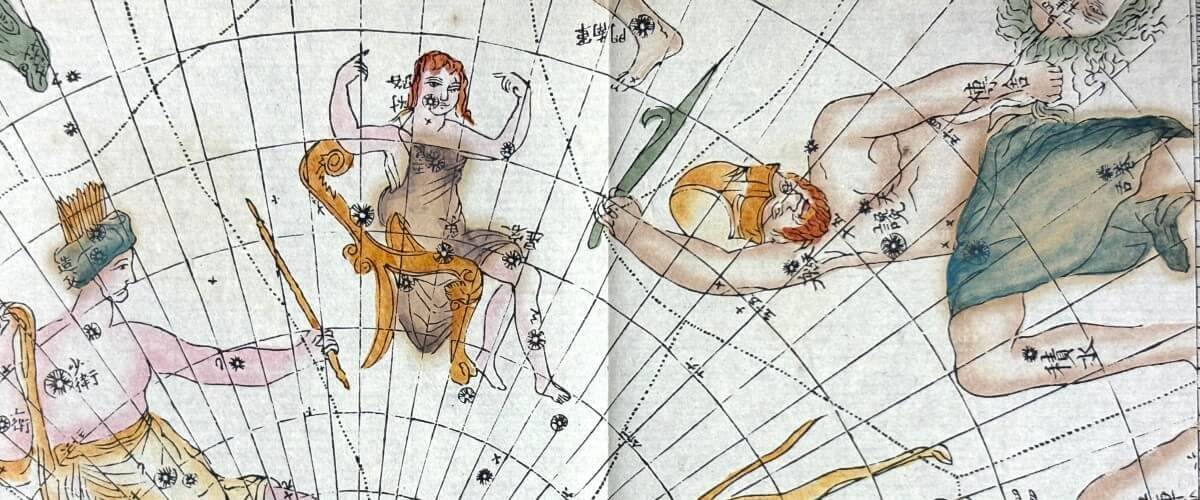
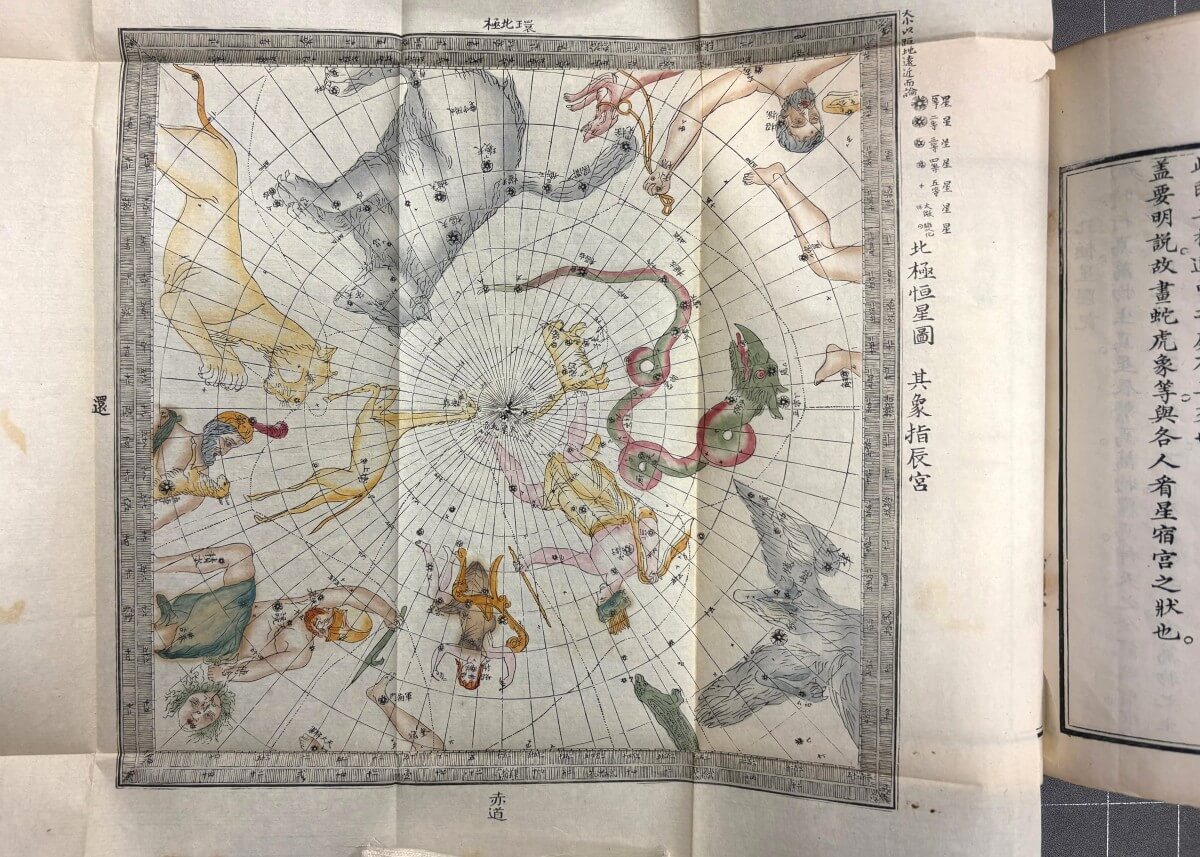
Subsequent issues of the magazine follow a similar format, but with content expanding to include Chinese classics, ethical teachings, market prices, astronomy and medical advices and other aspects of Western culture, offering readers news and knowledge from both their immediate surroundings and afar. Fold-out maps are a recurring feature in the publication, used as a strategy to help readers better engage with and understand the text. In addition to the map mentioned above, there are maps in our issues depicting the full territory of the Qing dynasty, Russia and the world. One of the more striking examples appears in the February 1834 issue (道光甲午年正月), which includes a celestial map of the northern constellations (北極恒星圖), each rendered in colour and annotated in detail (see featured image at the top). This is aesthetically pleasing to see even today, and must have been so for readers from almost two centuries ago.
Copies of Eastern Western Monthly Magazine have survived in a few other institutions, including most notably in the Harvard-Yenching Institute, where 39 issues are preserved. We have in our collection in total eight volumes, accounting for 11 issues of the magazine. Although this is an incomplete run, we have both the inaugural and final issues of the publication, giving us a glimpse of the evolvement of this short-lived but important magazine.
The Catalogue of the Chinese Library of the Royal Asiatic Society, published in 1838, describes only one volume of this periodical, listed as ‘Eastern and Western Ocean’s monthly investigations, by the Rev. C. Gutzlaff’ (page 58). It is again mentioned in our 1890 catalogue as ‘A Monthly Periodical of Foreign and Domestic News’, this time listed as eight issues (No. 549, page 98). It appears that the copies now in front of me are part of the Society’s earliest Chinese collection. As most of the Society’s historic Chinese books are no longer in its possession, I am delighted to see that these early publications have remained in our custody.
As you can see from the images above, the paper covers of some issues have detached and are crumbling. Dry cleaning to the items and rehousing will have to be done, and afterwards these will be properly catalogued, possibly onto the Library catalogue. In the meantime, if you have any questions or thoughts about these copies, feel free to get in touch!
~~~~~
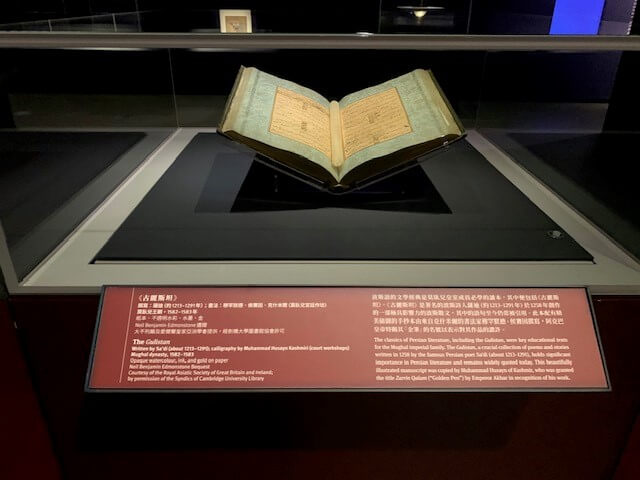
In other news, we have received a lovely message from Helen Tinsley, President of Royal Asiatic Society Hong Kong Branch (RASHK), and Connie Carmichael, Honorary Treasurer of RASHK, following their recent visit to the exhibition Treasures of the Mughal Court from the Victoria and Albert Museum at the Hong Kong Palace Museum. The is a touring version of V&A’s critically-acclaimed exhibition on Mughal arts and crafts held in London a couple of months ago, which featured our Persian manuscript Gulistan of Sa’di. For this special exhibition in Hong Kong, our manuscript is again featured as one of the exhibits. Here is an image from Helen, showing our manuscript on display:
The exhibition will run until 23 February 2026, so I hope our friends from Hong Kong and the wider region can get a chance to attend the exhibition to see our manuscript and other Mughal artefacts in-person!
James Liu