
Henry Faulds and his Japanese Buddhist Albums
We have had a few sweltering days in the Reading Room this week, but thankfully the weather has cooled off significantly, so it is a great relief. While the Society’s lecture programme is taking a recess over the summer months, we continue to be open for research visits. Indeed, summer tends to be the busier time of the year, as this is usually when researchers from overseas would have time to travel for research trips.
Over the past two weeks we have welcomed a number of researchers into our Reading Room to consult a variety of material, including photographs of North Borneo, letters with the Hong Kong Branch of the Society and publications on Indian Muslims, as well as papers of Thomas Manning and Sir Richard Burton (including his consular hat!). Among these, one visit paid by Dr Tomoë Steineck, curator and visual culture historian with the University of Zurich (UZH), piqued my interest in particular, so I thought I would jump at the chance to blog about this.
A while ago, Dr Steineck was introduced to the Japanese artwork collection of the Society by a Courtauld student. The collection aligns with a research project being undertaken by the Japanese Studies Department at UZH to study Japanese Buddhist art in European collections. Although the Society has a relatively small collection of Japanese artworks, among them are two intriguing albums related to Buddhism. The two albums were donated to the Society by Henry Faulds (1843-1930), a Scottish doctor, scientist and missionary, in October 1922. At the time of donation Faulds was a long-time member of the Society, having joined in 1883 after contributing to medical missions in Japan for almost a decade.

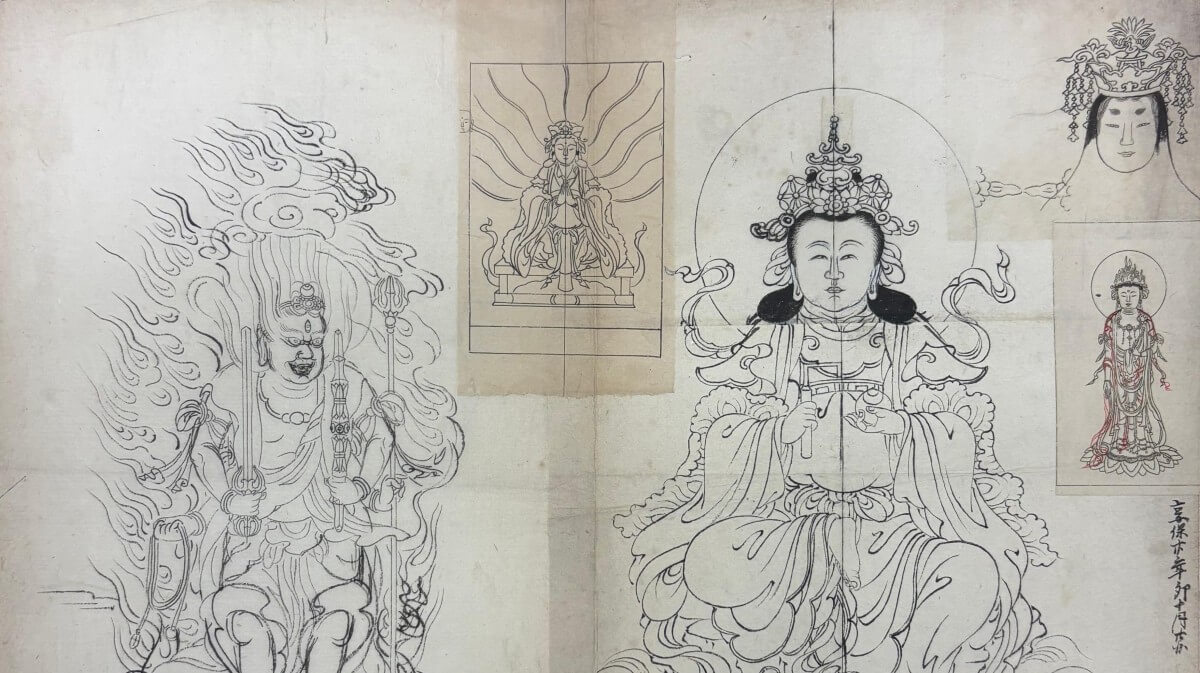
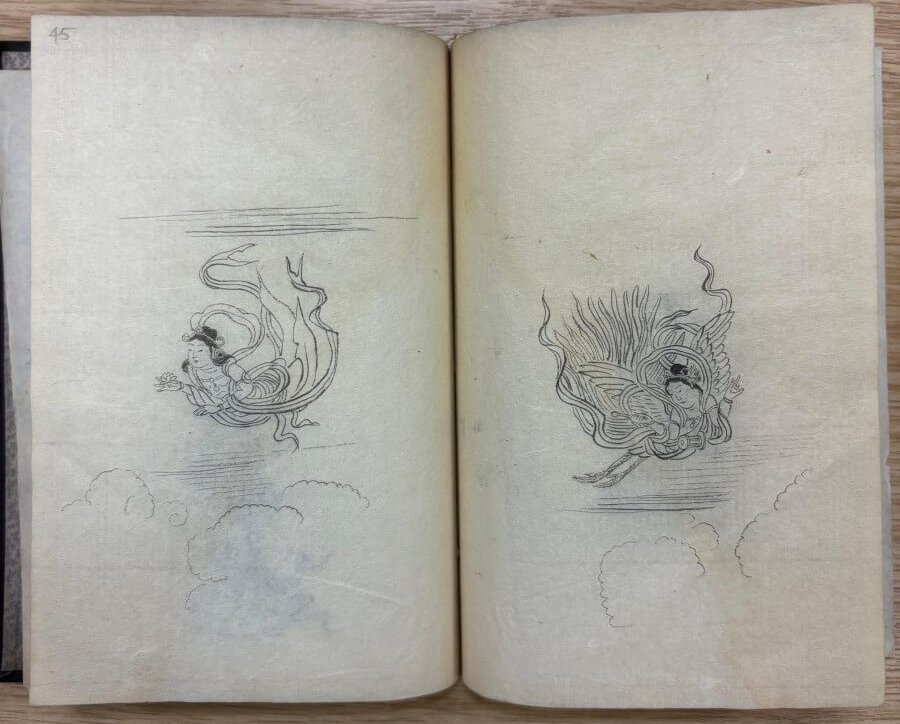
The first album (Head cat. No. 078) contains around 160 brush drawings which are said to be faithful copies of illustrations in a 1785 copy of Butsu-zo dzui (仏像図彙), a collection of Buddhist iconographic sketches first published in Japan in the late 17th century. According to Faulds, legend had it that copies of Butsu-zo dzui were ‘to be doomed to supernatural burning if reprinted’, so this album was hand-copied by his Japanese teacher ‘bit by bit’. The drawings have a lot of fine details, and albums like this can be important sources to study how iconographic details and depictions of Buddhist deities were standardised, disseminated and interpreted in Japan during the Edo period.
The other item (Head cat. No. 079) is a concertina album by an artist belonging to the atelier of Kanda Sotei, a lineage of artists specialising in Buddhist subjects. The album resembles an artist’s scrapbook, with around 50 drawings and sketches of Buddhist subjects pasted to the inside pages. These include both sophisticated drawings and rough sketches of Buddhist figures, identifiable with the inscriptions next to them. Interestingly, some sketches are cut to the shape and pasted onto pages with landscape paintings, so it almost feels like the creator was setting the Buddhist deities to the scenery and using that as a template for a subsequent work.
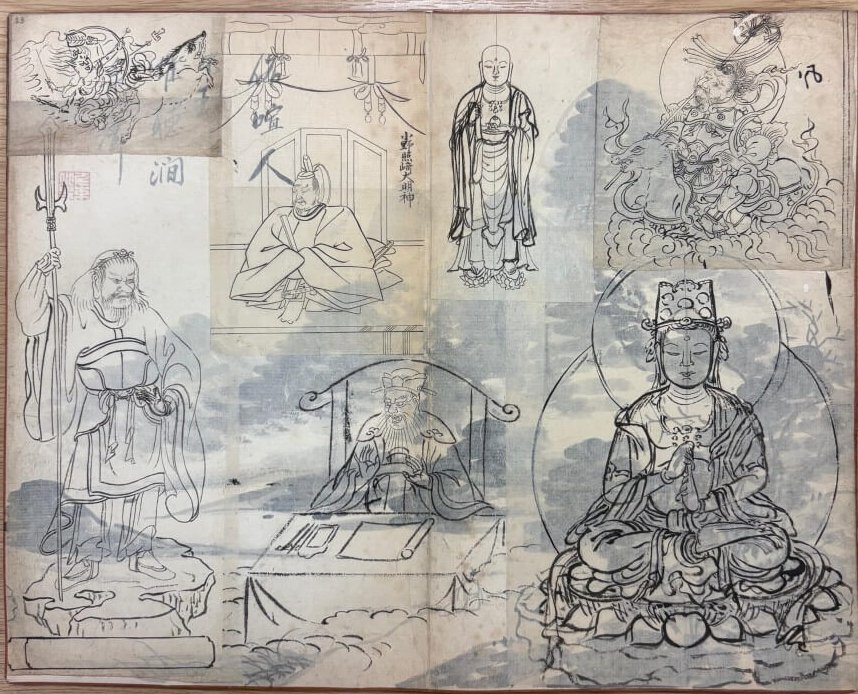
While more research is needed to ascertain the precise nature of the album, it offers a rare glimpse into the art-making process which is not always readily discernible from looking at a finished artwork. There is certainly also artistic merit to the album, as in Faulds’s donation letter he wrote that the album was ‘greatly prized by the Japanese scholars’. However, the legacy of Kanda Sotei and works by its artists appear to be underexplored in Western scholarship today, so I am excited to see what outcomes Dr Steineck’s research will lead to.
And now going back to Henry Faulds – he himself is also a largely forgotten figure, although he made significant contributions to the field of forensic science by pioneering the use of fingerprint for identification. Apart from the two albums, our Library holds a copy of Faulds’s illustrated book entitled Nine Years in Nipon, which was published in 1885 after his return to England from Japan. Faulds clearly had an interest in Japanese Buddhism, as can be seen from his collecting of the above albums, but the book was written for a much wider appeal, detailing his everyday observations from living and working in Meiji Japan. Subjects covered range from street scenes and natural history to Japanese manners and customs, and the pages are interspersed with small illustrations depicting local plants, animals and people. The illustrations are lovely, but for me the striking cover art of the book, featuring what looks like a Japanese kappa (literally ‘river child’, a water-dwelling creature in Japanese folklore) catching a fish, is not to be missed:

If you are interested in seeing the albums or reading the book in person, get in touch with us for more information. In the meantime, enjoy the summer breeze!
James Liu