

Staff Intro, Noh Theatre Chants and Prize Reminder
This week, we open our blog with a piece written by Evelyn Dodds, who joined the Society last week as our new Outreach and Communications Officer. Some of you may already recognise Evelyn – she’s been one of the friendly faces greeting visitors at our recent events. Below, she shares a short introduction about herself and a glimpse into what she’s looking forward to in her new role:
Hello! I’m Evelyn, the new Outreach and Communications Officer for the RAS.
Before taking on this role, I was a museum professional in curatorial roles for local history museums in British Columbia, Canada. I studied North American Indigenous archaeology and museum studies, which sparked my interest and subsequent work in decolonisation practices. Unfortunately, Covid 19 dried up a lot of the already limited museum work in Canada, so I relocated to London in 2024.
I was in search of a career change and took on User Experience research contracts and measuring audience engagement for the Royal Institute of British Architects. I also worked for the RAS on a casual basis and really enjoyed being a part of a warm and interesting community.
A bit about me personally, I am and avid baker, particularly layer cakes, and I make upcycled denim dog jackets inspired by my Mexican rescue pup, Geri. I also love to travel and spent a couple months in Japan, Thailand and Cambodia where I became enamoured with the history and cuisine. Before moving to London, I went on a four-month road trip through the United States and Mexico. I am currently planning my honeymoon in Sri Lanka.
I am very pleased to have found my place with the Royal Asiatic Society. I have enjoyed diving into the incredible Journal of the RAS and learning about the society’s history. I am excited to continue learning and getting to know the people who make up this wonderful society.

Upcoming Events
The Society’s next event takes place on Thursday 26 March, when we’ll be celebrating the launch of Dr Melanie Gibson’s recent publication on British artist Frederick Leighton and his Arab House. Dr Gibson will be giving a talk to mark the occasion, and you can find full details on this page.
We’ll then round off March with a special event from our Japanese Studies lecture series. On Tuesday 31 March, we’ll be hosting a demonstration and discussion on Noh masks, the carved wooden masks worn by performers in classical Japanese Noh theatre. For this event, master mask carver Kitazawa Hideta, author Jannette Cheong and Dr Margaret Coldiron will guide us through the process of creating and working with these hauntingly beautiful masks.
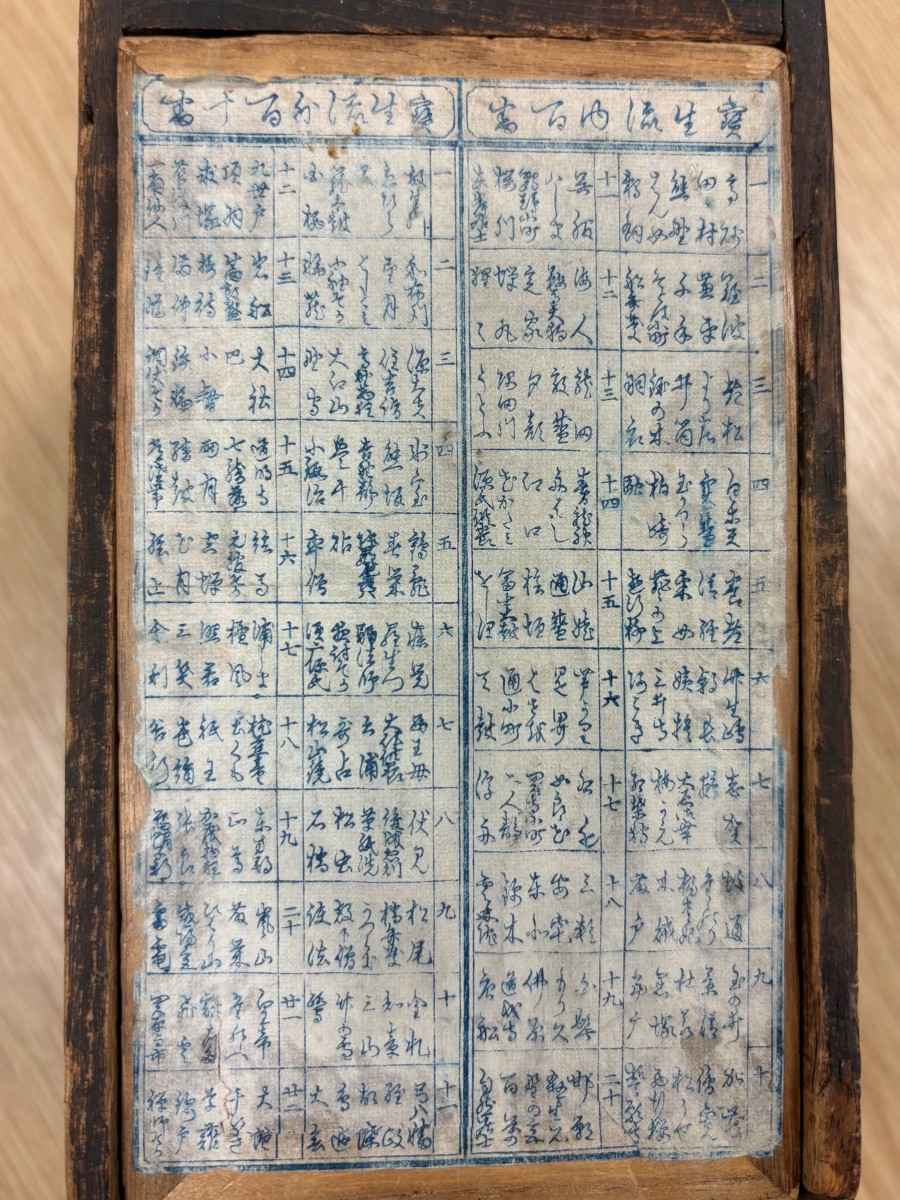
And speaking of Noh theatre, I thought this would be the perfect opportunity to introduce a relevant item from our special collections that I catalogued a few months ago. During one of my usual hunts through the basement repository, I came across a small wooden box on a shelf, apparently untouched for a very long time. When I slid the lid open, I found two sets of palm‑sized booklets resting neatly in separate compartments:

This is a collection of printed chanting booklets of the Hosho school of Noh theatre. Noh comprises several schools, each with its own performance and singing style, and Hosho is the second largest among them. Traditionally, each school maintains a standard repertoire of chants, written in an utaibon – a chanting book used for performance and training. But an utaibon is more than just a script. Alongside the lyrics, it often includes musical notation and sometimes choreographic directions, annotated to the right of the lines to indicate how each syllable or phrase should be sung or performed (see the featured image of this post for an example form one of our chanting books).

This particular set contains 10 booklets of common chants and 11 booklets of less frequently performed ones, amounting to around 220 chants in total. The underside of the wooden lid features a printed list of all the chants included. Although the exact date of production for this set is unknown, many such booklets were printed in Japan and circulated among Noh theatre artists during the Edo period, when printing technology was rapidly developing in the country. By examining chanting books like this, we can trace how both specific Noh schools and the larger tradition have adapted and transformed their performance styles across generations. You can find the catalogue entry for this item in our Archive catalogue here.
I hope this brief introduction sparks your curiosity about this centuries‑old Japanese art form. While there won’t be chanting at Hideta’s event, it offers a rare chance to explore how iconic Noh masks are crafted and used for both traditional and contemporary performances, so I hope you’ll enjoy discovering the artistry and symbolism that have shaped this theatrical tradition for generations. More details about the event and the speakers can be found on this page. If you would like to attend the event online, register by emailing Evelyn at emd@royalasiaticsociety.org.
Prize Reminder
Before closing this week’s blog post, a quick reminder that nominations for the 2026 James J. Busuttil Medal and Prize for Human Rights will be closing soon on 31 March. It also feels timely to note that Human Rights Day will be observed in South Africa tomorrow, 21 March. In that same spirit, we hope to see continued efforts across the global community to recognise and celebrate human rights achievements.
Full details about the award and how to submit a nomination can be found on this page.