

Chinese Scrolls and Staff News
In a previous blog post, I promised to share more about the Chinese scrolls I’ve been working on, so this week I’m diving deeper into two of them, both of which have revealed some fascinating stories.
These are a pair of hanging scrolls featuring reproduced rubbings of mythological emperors from early Chinese history. The set carries a title that translates literally to ‘Pictures of Emperors’, and each picture on the scroll is accompanied by various inscriptions and ownership seals.

There’s quite a lot happening on these scrolls. When I ran the images through an online search, the first major connection that surfaced was the stone carvings of the Wu Liang Shrine. Built in AD 151 for the Confucian scholar Wu Liang, the shrine is located in what is now southwestern Shandong province in China. The stone carvings found in the shrine is almost like an ancient visual encyclopedia: a sweeping pictorial narrative filled with scenes from history, mythology and folklore, populated by more than a hundred figures ranging from emperors to everyday people. There are images of the rubbings of the stone carvings in full available online, such as this one:
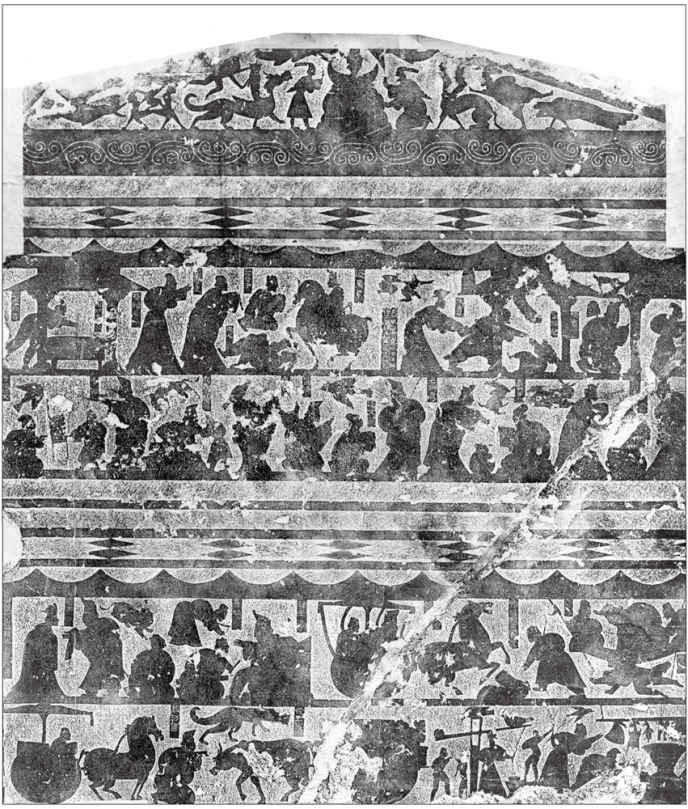
The Palace Museum in Beijing also holds a rare Song‑dynasty book of rubbings taken from these very carvings. Although the book was damaged by fire, it remains the earliest surviving visual record of this nearly two‑millennia‑old monument, as you can see from some images in this link: https://www.dpm.org.cn/collection/impres/234583.html
But our scrolls aren’t direct rubbings from the Wu Liang Shrine carvings, nor are they the Song‑dynasty version. Further digging revealed that they actually trace back to a Qing‑dynasty compilation that focused specifically on the mythological emperors depicted in the original stone carvings. The Qing period was when the Wu Liang Shrine was re‑excavated and once again drew scholarly attention. From that point through the Republican era, new rubbings of the shrine’s carvings and inscriptions were produced, some of which survive today in museums and libraries.
It’s probably the format that makes our scrolls stand out. They aren’t simply pages lifted from the book and mounted onto silk. Instead, the pictures are on a single, continuous sheet, suggesting it was printed as a broadsheet from the start and intended to be a scroll for appreciation. I can almost picture these scrolls hanging among bookcases in the study of a late‑Qing literatus, their gaze drifting from text to image as they pondered the legendary feats accomplished by the earliest Chinese emperors…
The scrolls have now been catalogued under Special Collections in the Archive catalogue here, sitting alongside another collection of Chinese rubbings made from steles also dating to the 2nd century, which I catalogued a few months ago. Could these items, given their thematic connection, arrive the Society as a single donation? It’s certainly possible, but unfortunately, I have yet to find further ownership or provenance information to make this claim. In any case, these scrolls are nice additions to the collections and I hope that by getting them catalogued and properly documented we could reveal further information around their history.

Staff News
This week, we bid farewell to Matty Bradley, our Events and Outreach Officer, who is leaving the Society for pastures new. If you’ve attended one of our lectures or book talks in recent years, you may well have met or corresponded with Matty. He has been the driving force behind organising and running our events, particularly the Zoom streaming arrangements that have enabled us to reach audiences far beyond London. Matty has also been the first point of contact for many enquiries about venue hire and our Journal.
Thank you for the hard work, Matty! We are sad to see him go, but we wish him every success in his next chapter. Below, we’ve included a short interview with Matty reflecting on his time at the Society since joining us in 2018.
—
Q: What originally attracted you to this role?
A: The Royal Asiatic Society has such a distinguished history and a unique position as a bridge between academic research and wider audiences interested in Asia. The opportunity to help shape events and outreach around its collections, lectures, and research felt like a chance to make that scholarship accessible and alive.
I was also particularly attracted to the diversity of topics the Society covers, across regions, disciplines, and historical periods and the challenge of presenting them in ways that resonate with both specialists and the general public.
Q: What aspect of your role did you enjoy the most?
A: There’s something incredibly rewarding about seeing a room, or a virtual audience, engaged in thoughtful discussion, especially when the subject matter might otherwise feel niche or academic.
I also really valued working with fellows, scholars, and speakers from a wide range of backgrounds. Facilitating conversations between established academics, early-career researchers, and curious members of the public felt like a meaningful contribution to the Society’s mission.
Q: During your time here in what ways do you think the Society has evolved, and how do you feel about that?
A: During my time here, I think the Society has become increasingly outward-facing and accessible. There has been a growing emphasis on widening audiences, diversifying speakers and topics, and embracing digital platforms to reach people beyond London.
I’ve also seen a stronger focus on collaboration, both with other cultural and academic institutions and with communities whose histories and cultures are represented in the collections. That shift feels important and timely. It honours the Society’s long history while ensuring it remains relevant and responsive in the present.
Q: What are some of your most memorable moments working at the Society?
A: The bicentenary celebrations in 2023 were such a joy to be part of. It was a rare opportunity to reflect on the long and complex history of the Society, celebrate its achievements, and think critically and ambitiously about its future. A particular highlight was the Extraordinary Endeavours exhibition, held at the Brunei Gallery. Seeing the Society’s collections presented in such a public and visually compelling way, and witnessing the response from visitors who may not previously have encountered the Society, was incredibly rewarding.
—
James Liu