
An Archival Reunion
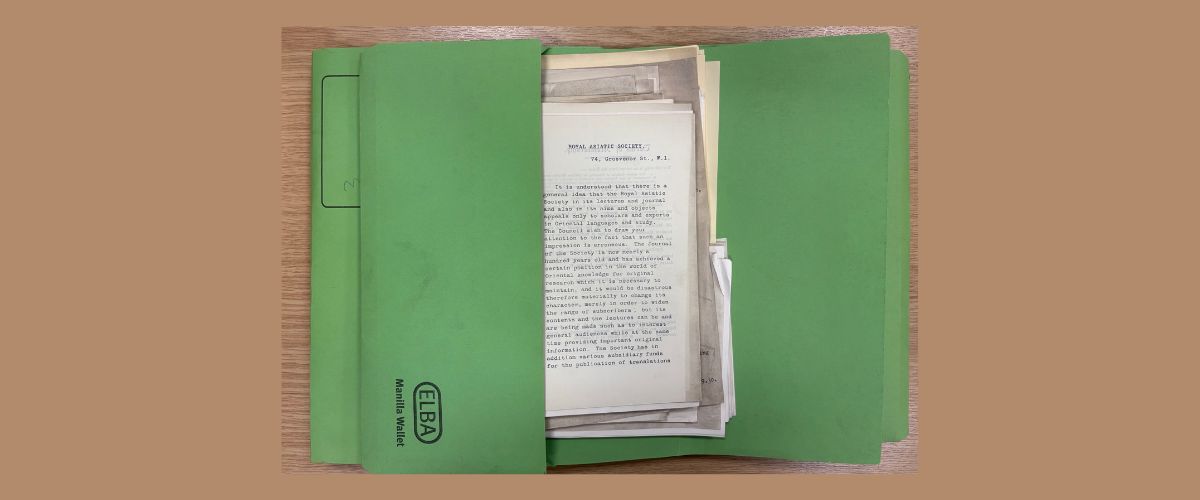
Last month, we were contacted by the Archivist at the Royal Anthropological Institute about a set of institutional papers belonging to the Society that had been in their custody for some time. We were told that the material – four manila folders in total – contained early 20th‑century correspondence and printed items that might be of value to the Society.
The papers have now been transferred back, and I’ve finally had the chance to examine them properly. Most of the material consists of correspondence addressed to the Society in the 1930s, relating to the premises at 74 Grosvenor Street, our home from 1920 to 1947. Much of it is administrative – letters between the Society’s Secretary, Colonel Hoysted, and various service providers responsible for cleaning, drainage, gas works, building works, fixtures and library shelving.
Although largely routine in nature I found the letters unexpectedly enjoyable. They illuminate a side of the Society’s organisational history that is not often documented. One particularly entertaining discovery was just how many rugs the Society owned. A carpet cleaning company’s estimate from 1934 lists an Indian carpet in the Assistant Secretary’s room, a 12’ x 15’ Turkey carpet in the Secretary’s room, two Persian rugs in the Library, and various curtains and cloths in other rooms – altogether amounting to £10.1.0 for cleaning. Colonel Hoysted’s reply, regretting that the Society was ‘unable to find the money conveniently for the cleaning of the carpets etc. of the House at present,’ is also quite revealing about the Society’s financial situation during the 1930s.

Among the printed material I’ve found several leaflets promoting the Society’s Journal and other publications. These would have been circulated among libraries and other learned societies so it’s perhaps not surprising to see some copies found their way into the Institute. However, one leaflet, dating to an earlier time when the Society occupied the premises at 22 Albemarle Street, caught my attention.
It is a printed memorandum entitled ‘Memorandum respecting the Royal Asiatic Society, for circulation in Egypt’, of which I haven’t yet found another copy in our institutional records. The memorandum outlines the history and activity of Englishmen in Egypt, reasserts the Society’s role in the study of Egyptian subjects, and ends with a call for papers from Egypt in fields such as linguistics, literature, archaeology, religion and contemporary manners and customs. One extract reads:
‘Egyptology is a separate branch that is dealt with societies formed for that special object; but Egypt of more modern times down to the present day is inseparably bound up with some of the most important subjects of investigation that the Society includes its purview. As instances, Islamic literature and Islamic art may be taken… It may be added that there is no other Society in England that concerns itself with Egypt from Oriental point of view.’

Curious about why the Society felt compelled, in the first decade of the 20th century, to reaffirm its role in Egyptian studies and to issue a memorandum, I turned to the Minutes of Council. The memorandum was approved in March 1910 and drafted by Arthur Rhuvon Guest and Sir Charles Lyall, both Arabic scholars and members of the Council. Although the content of the memorandum was not recorded in the minutes, the motivation for writing it was mentioned in a previous meeting:
‘Mr Guest’s proposal that steps be taken to increase the number of members connected with Egypt and the Sudan was agreed to. It was left to Mr Guest and Sir Charles Lyall to draw up and present a memorandum to the Council.’
We already know that the Society made some efforts to revitalise its membership in the early 20th century, for we have several surviving letters or leaflets issued by the Society relating to this from this period. But this memorandum is special as it targeted a specific geographic community, for distribution to Europeans in Egypt. It also seems to go above and beyond its original purpose of promoting membership, and goes to great lengths to illustrate the Society’s role in Egyptian studies and invite for scholarly contributions to the Journal.
I’m glad to be able to share these little discoveries from this unexpected ‘archival reunion’, and this would not have been possible without the help of the Archivist at the Royal Anthropological Institute. Our special thanks go to her for reaching out to us and initiating the transfer, which has allowed us to fill a small but meaningful gap in our understanding of the Society’s organisational history. Following the transfer, the papers have been dry-cleaned, catalogued and rehoused, now reunited with the remainder of the Society’s institutional records. If you are interested, the catalogue of the correspondence relating to building works can be found here.
Upcoming Events
We have two events scheduled for the remainder of April. On Thursday 23 April, we’ll welcome Peter Kornicki, Emeritus Professor of Japanese at the University of Cambridge, to speak on the dynamics between manuscript and print production in Edo-period Japan, as part of our Japanese Studies lecture series. His talk will shed light on why manuscript production continued to flourish in Japan during that era, despite the emergence of print culture. More information about the lecture and the speaker can be found here.
And then on Thursday 30 April, Dr Yashaswini Chandra, Lecturer in South Asian Art History at the University of Edinburgh, will speak on the interracial relationships between British men and Indian women in colonial India. Details of the event can be found here. Please note that this event will not be recorded or broadcast over Zoom, unlike most of our other events, so we encourage you to join us in person if possible.