
All Things (Un)Published
Recently, I’ve started cataloguing the Society’s Publications archive – records documenting the Society’s long history of publishing. Many of you will know that the Society has played a key role in advancing original research in Asian studies, with the earliest major publishing initiative being the Oriental Translation Fund, established in 1828 to translate and publish important works from Asian languages in English. In the early 20th century, the Society expanded its publishing activities even further, launching and managing several programmes, including the Asiatic Monograph Series, the predecessor of our Monograph Series today, and the Prize Publication Fund. There were also smaller publication series named after benefactors such as the James G. Forlong Fund series and the B. C. Law Trust Series, each contributing to the Society’s mission of supporting scholarship in Asian studies.
The box I worked through this week was filled with correspondence relating to several early‑20th‑century publications – some that ultimately went to print and others that never made it beyond proposal. Taken together, they give an indication of the breadth of subjects that the Society took interest in, as well as its role in nurturing Asian studies by supporting the publication of scholarly work – a commitment that that it still dedicates to today.
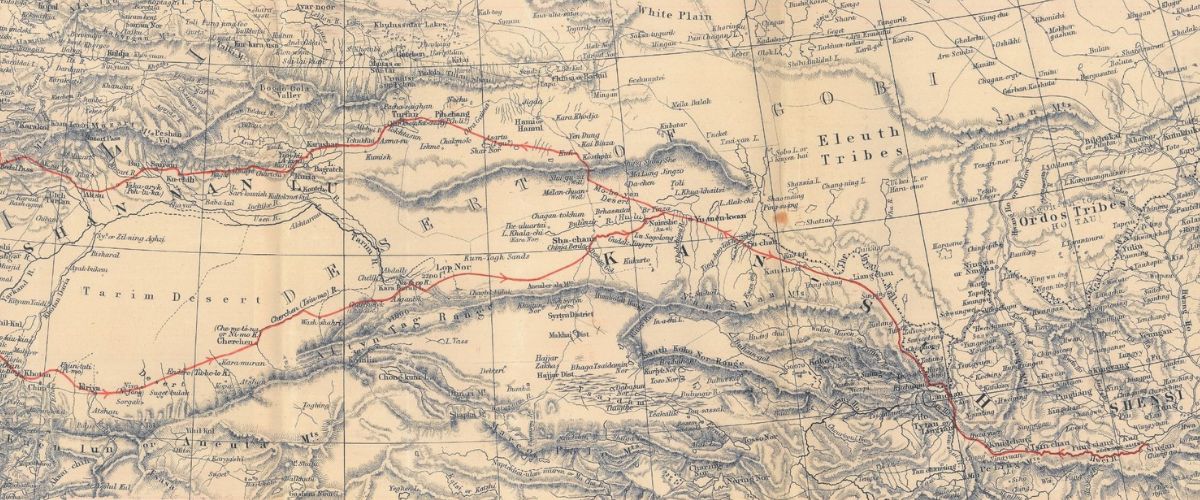
One publication highlighted in the correspondence is Thomas Watters’s On Yuan Chwang’s travels in India, 629-645 A.D., published posthumously in two volumes in 1904-05 as part of the new series of the Oriental Translation Fund. The book is an account of the famous pilgrimage undertaken by the Chinese Buddhist monk Yuan Chwang in the 7th century, during which he travelled through Central Asia to India to collect Buddhist texts. The archival material includes letters concerning the printing of the book and the production of a map by Vincent A. Smith to illustrate the monk’s journey through Central Asia. Interestingly, the volumes were printed in Leipzig by a German printer W. Drugulin, and the correspondence reveals that the printing process was delayed due to the illness of the only Chinese typesetter of the press and their subsequent call-up for military training.

The correspondence also shows the Society’s active role in promoting Asian studies, particularly in the fields of Indian history and literature. In 1900, the Society proposed to the Government of India the creation of a series of historical volumes for India. This led to the establishment of two series – the Indian Texts Series, dedicated to translations of works by Indian writers of importance for the history of India; and the Indian Records Series, which published selected records from the Indian government and the India Office. Although the initiative originated with the Society, the printing and publishing of both series were later entrusted to the publisher John Murray. It was agreed, however, that the Society would retain a certain degree of editorial oversight of the Texts series through its Secretary, Professor Rhys David, who also served as the series editor. A committee was also founded by the Society to consider matters relating to the series.

Unfortunately, Professor Rhys David’s retirement from the Society in 1905 meant that the organisation gradually lost much of its influence over the editorial direction of the series. The first volume of the series, An Arabic history of Gujarat, edited and translated by Dr Denison Ross, did not appear until 1910. Looking at the early publications of the series today, it seems that the Society’s involvement in initiating the two series has largely gone unacknowledged. This makes the surviving correspondence – mostly between the Society and the India Office – an important record of a lesser‑known chapter in the Society’s publishing history.
Another set of correspondence relates to a work that was never published by the Society – a study of early Manipuri language written by a local author Yumjao Singh in the 1930s. Drawing partly on material from a grammar work by William Pettigrew (1869-1943), the missionary who translated religious texts in regional languages in Manipur, the manuscript was submitted to the Society for consideration by Christopher Gimson (1886-1975), who was appointed political agent of Manipur in 1933. Discussions about its potential publication continued for nearly a decade, but the difficult conditions created by the ongoing war made the project increasingly unviable. By 1941, the Council felt that it would be more practical for the book to be published in India instead.

As I reviewed this set of correspondence, it became clear that the material is of mixed provenance, with one set of letters of William Pettigrew donated to the Society by his wife along with his personal papers in 1943. The correspondence isn’t all about the proposed publications either – Gimson remained in contact with the Society through the 1960s regarding his interest in encouraging the study of the history of Manipur. To reflect these contexts, Pettigrew’s letters will be added to his small collection of personal papers (already catalogued here). Gimson’s correspondence has been extracted to form a separate fonds, which I’ve done so here: https://www.royalasiaticarchives.org/index.php/papers-of-christopher-gimson
One box down, with a dozen more to sort through, and I’m sure I’ll discover more interesting stories from all things published (or unpublished) by the Society in its long history of publishing…