
A Fortnight at the Royal Asiatic Society
Last month, we were pleased to welcome Anna, an undergraduate at the University of St Andrews, for a two‑week placement in the Library. The Society periodically hosts volunteers and students who assist with simple library and archival tasks, gaining practical, hands‑on experience while helping us enhance the description and interpretation of our collections. During her time with us, Anna worked on a photographic collection as well as a small group of miscellaneous artworks.
Below, we share a short reflection she has written on her experience. We are sincerely grateful for Anna’s time and commitment, and we wish her every success as she continues her studies and embarks on her future career.
~~~
Hello everyone! My name is Anna Huang, and I am a fourth-year undergraduate at the University of St Andrews studying Art History. In June, I completed a two-week work placement at the Royal Asiatic Society, where I had the pleasure of becoming acquainted with its dedicated staff, particularly Edward, the head librarian, and James, the archivist. They introduced me a range of new skills and I was able to get a real taste of their everyday work. I would like to first and foremost express my gratitude for their generosity, patience, and unwavering effort to make my experience as enriching as possible.
The most defining component of my placement was the cataloguing of one of the Society’s newest acquisitions: Professor Christopher J. Fuller’s photographic collection from his fieldwork in the southeast Indian region of Tamil Nadu (1976–1995). Over two decades, Professor Fuller conducted research on the great Minakshi-Sundareshwara temple in Madurai, its elaborate rituals, and its priests, whose lives changed markedly over this period. In preparation for my placement, I read one of the books that emerged from this extensive fieldwork, The Renewal of the Priesthood: Modernity and Traditionalism in a South Indian Temple, which introduced me to the vibrant world of the temple and better equipped me to work with the collection. I was honoured to meet Professor Fuller himself during my placement; he was happy to share more about his experiences and to answer any questions that would help inform my cataloguing process. Hearing him speak about the temple and his encounters with its priests and devotees brought even greater character and life to these fascinating images.
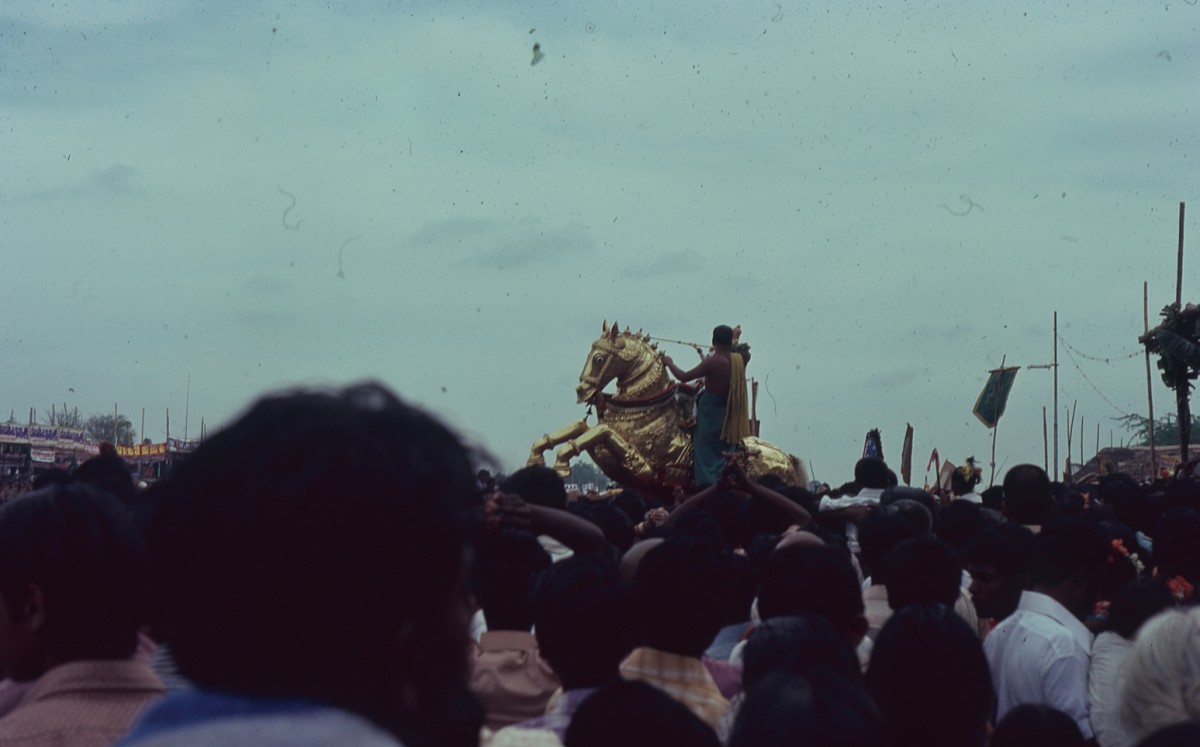
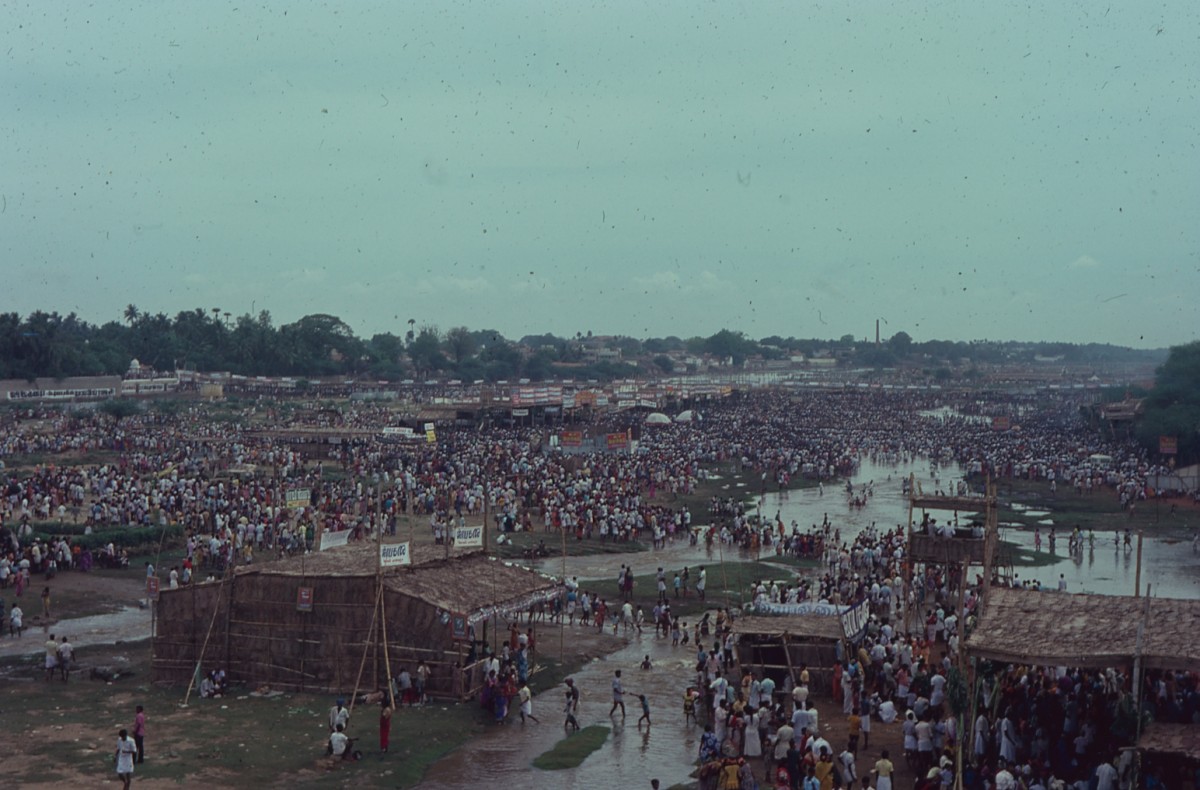
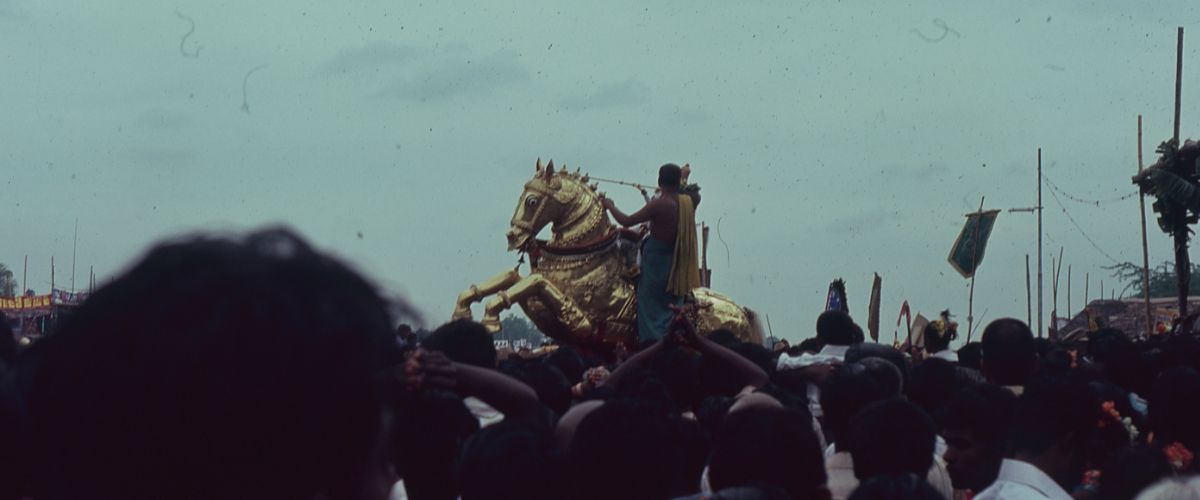
Out of all the events documented in the collection, some of my favourite photographs were taken during one Chittirai festival, at the enactment of the god Kallalagar’s arrival on horseback in Madurai for the wedding of his sister, Minakshi. As Professor Fuller recounted with some amusement, Kallalagar is famously late and misses the wedding entirely. His images of Kallalagar’s arrival struck me particularly for their setting on the vast banks of the beautiful River Vaigai, and for the thousands of people gathered simply to witness and celebrate the sighting of the god, astride a golden horse gleaming above the crowd.
My first task was to sort through the image scans—taken from hundreds of photographic slides, prints, and negatives—and assign them catalogue numbers. The numbering would determine the sequence in which future researchers encounter the collection, and therefore necessitated a logical and coherent order. A chronological arrangement seemed most fitting for Chris’s collection and research, which was shaped by his periodic trips and the evolution of the temple he observed across them. Working in Excel, I organised the images as precisely as possible, down to months, days, and individual festivals or events. Once the photographs were numbered, my next task was to write brief captions for each. This process was aided by several documents of captions Chris had written himself, which I expanded and revised in turn. With the order and captions finalised, I repackaged each image, labelling it with its newly designated number, so that the collection could be arranged sequentially in a new collection box. My final task was to write a title and brief description for the collection’s new entry on the online catalogue—you can find it by searching its call number, Photo.91!
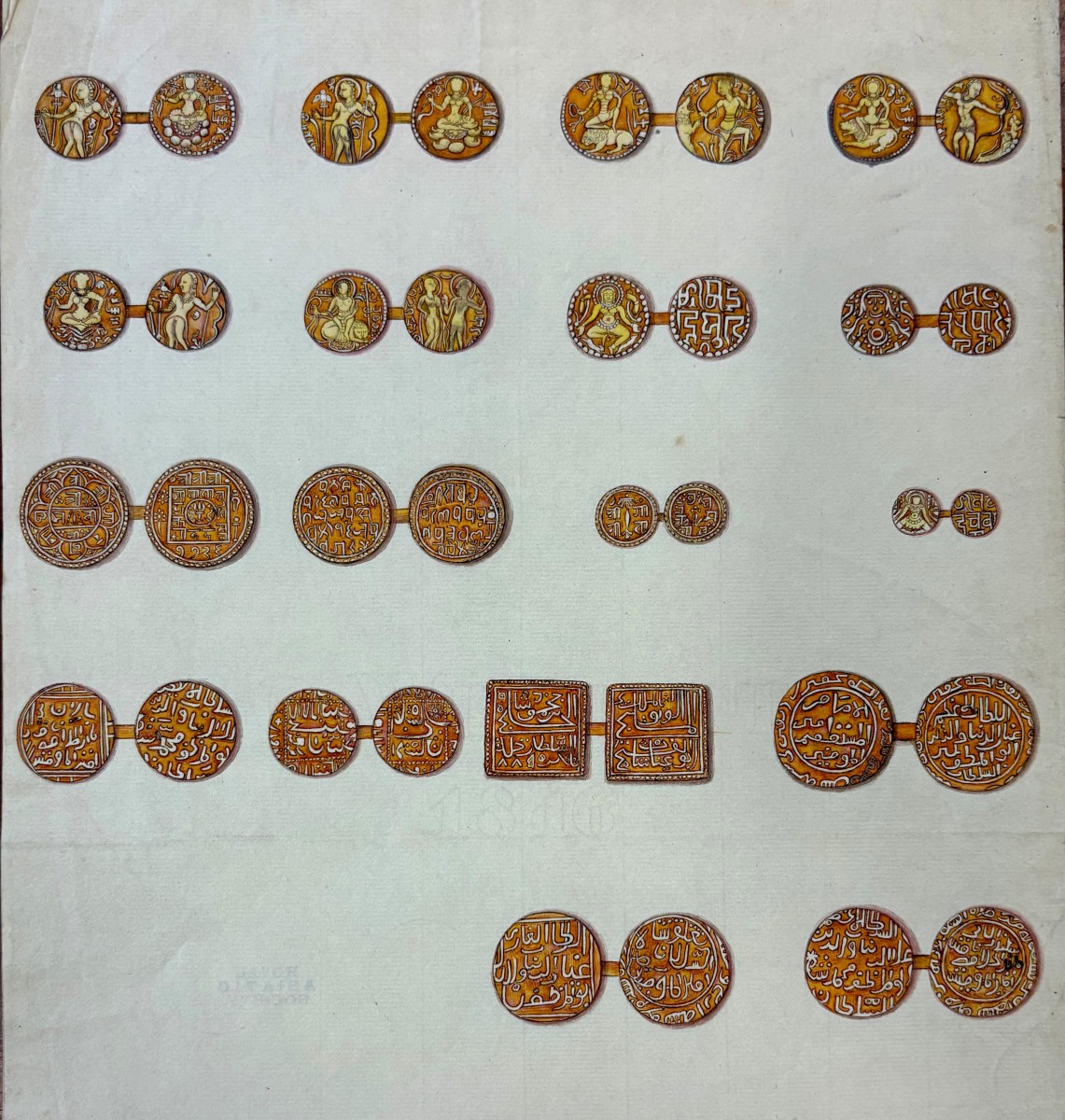
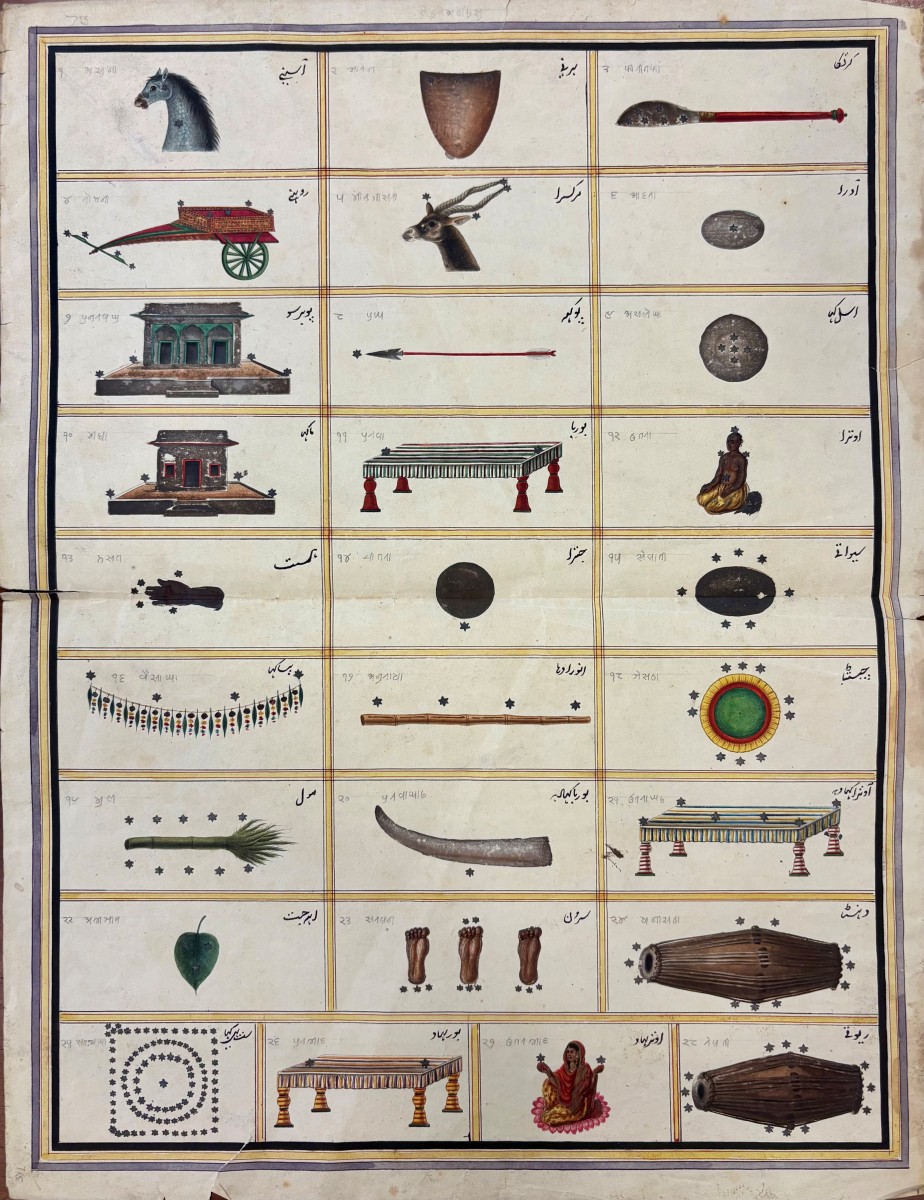
The remainder of my time at the Society was largely devoted to cataloguing items from several boxes of miscellaneous artworks. This proved unexpectedly exciting, as the subject matter was tremendously diverse—I never knew what I would encounter next. Some items were a lot more difficult to glean information from than others, calling for investigative work and deep dives on the internet. One of the more prominent works I catalogued was a large number of numismatic drawings (037.181-037.194) attributed to the collection of James Tod, some of which were used in plates in his publications, such as “An Account of Greek, Parthian, and Hindu Medals, Found in India,” featured in Transactions of the Royal Asiatic Society of Great Britain and Ireland, Vol. 1, No. 2 (1826). A more challenging identification—the item being inscribed solely in German and lacking any previous archivist’s annotations—but equally interesting was an early nineteenth-century (123.001), allegedly taken after the celebrated travels of the Baltic German explorer Johann Güldenstädt (1745–1781) and reportedly referenced frequently by Heinrich Julius Klaproth, another German explorer and Orientalist (1783–1835). Working through these miscellaneous boxes taught me a great deal about places and people I would never have encountered in my usual courses of study.
My work throughout the placement was not often as straightforward as I initially assumed. I quickly learned the importance of thinking strategically about each task and how it might be completed most efficiently and cautiously, as unexpected elements or items unaccounted for could overturn the entire process. I learned that archival work and collections management are as much exercises in judgement as in organisation. Every decision, from the sequence of a photographic collection to the phrasing of a single caption, shapes how future users will access and interpret an archive. I also came to appreciate how much archival work depends on conversation and collaboration—with colleagues, and where possible with the creators of the collections themselves, whose knowledge and experience can critically help an item be better understood (and not misunderstood!).
Above all, my placement gave me a new appreciation for the meticulous work that underpins scholarship today. So much of what researchers rely on depends on the often unseen work of librarians and archivists who have made that material accessible in the first place. Having now contributed a little bit to that process, I will never look at my own research in the same way. I leave the Royal Asiatic Society with new skills, broadened interests, and deeper respect for the institutions that preserve and share our pasts. I am immensely grateful for the experience, and I would encourage any student with an interest in history, archives, or collections to consider undertaking a placement as well!