
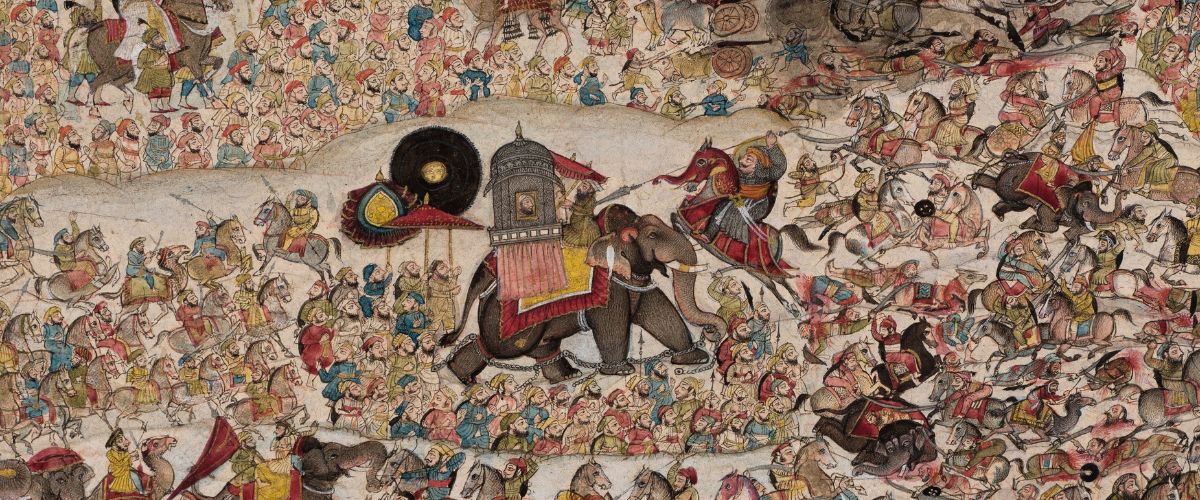
Haldighati@450
This week, our President, Dr Norbert Peabody, writes about the Society’s painting of the Battle of Haldighati, reproduction of which is now on view in a special exhibition at the City Palace Museum, Udaipur. Read on to discover the nuances and historical puzzles woven into this striking work!
~~~
This past June 18th saw the 450th anniversary of the Battle of Haldighati (in central Rajasthan) between the Mughal armies of the emperor Akbar and the forces allied to Maharana Pratap Singh of Mewar. The Society is fortunate to have an early 19th century depiction (c.1822) of the battle by the famous Mewari artist Chokha. This painting was produced for Lt-Col James Tod (1782–1835), the first British Political Agent to the Western Rajput States (1818–22) and the Society’s first Librarian. The Society’s painting is one of five known depictions of the battle that Chokha produced during the period of c.1820–25. Two of these paintings remain in Mewar, and two are now in collection in the USA. Interestingly, each of the five paintings depicts the battle differently. The City Palace Museum in Udaipur has just opened an exhibition that brings all five of these paintings together in large scale reproductions and explores the relationships amongst this corpus of depiction. This exhibition is open until mid-August and if you happen to be visiting Udaipur during the rainy season please visit it.

Of the five paintings by Chokha depicting the Battle of Haldighati, the Society’s painting is perhaps the most enigmatic and befuddling. Like Chokha’s four other compositions concerning the battle, the RAS’s painting is constructed around a continuous narrative in which Rana Pratap is depicted several times. In the present example, Pratap appears seven times and his ‘Mughal’ antagonist appears three times in various episodes that have become associated with the battle. Three of these episodes are now iconic in how Haldighati has been remembered and are instantly recognizable in this painting. Interestingly, none of these three episodes appear in the literary canon surrounding the battle until the century after the battle.
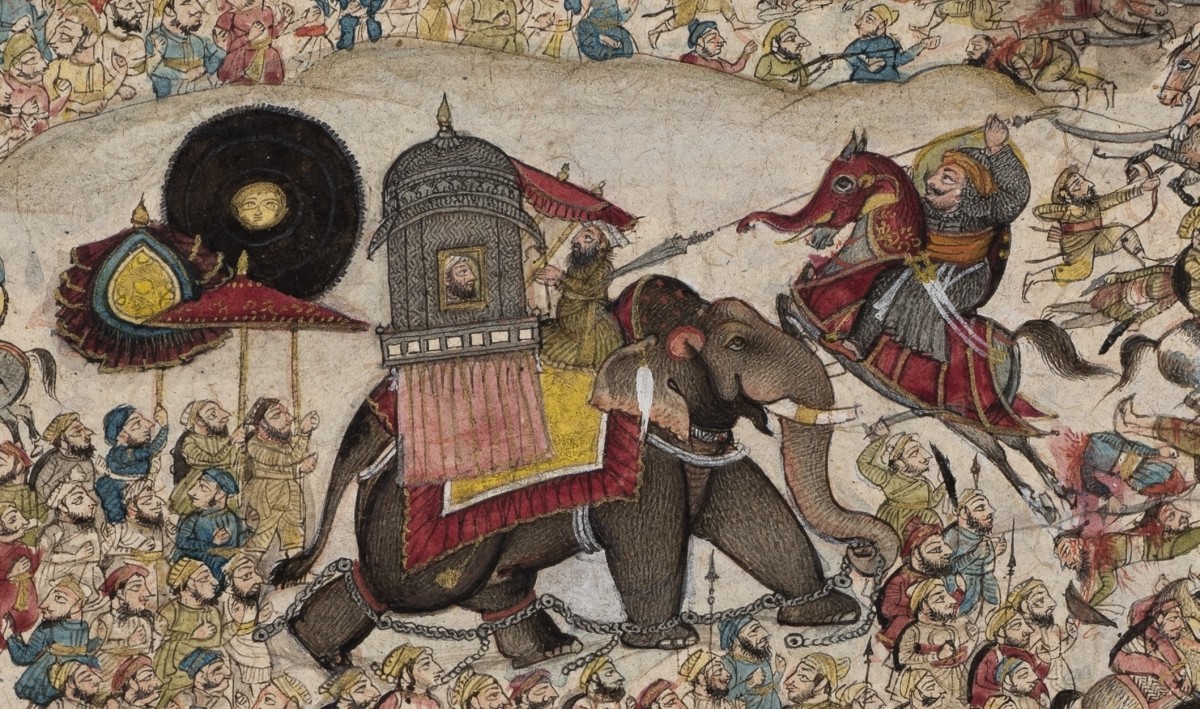
The most instantly recognizable of these episodes is the central confrontation between Rana Pratap mounted on his faithful horse Chetak and a ‘Mughal’ commander in a silver howdah atop a war elephant. The elephant is in musth as is evident in the swollen, pink temporal gland behind the eye, from which tar-like temporin secretes, and the heavy chains shackling his feet. Pratap is in the act of letting fly his lance which just misses its intended target.
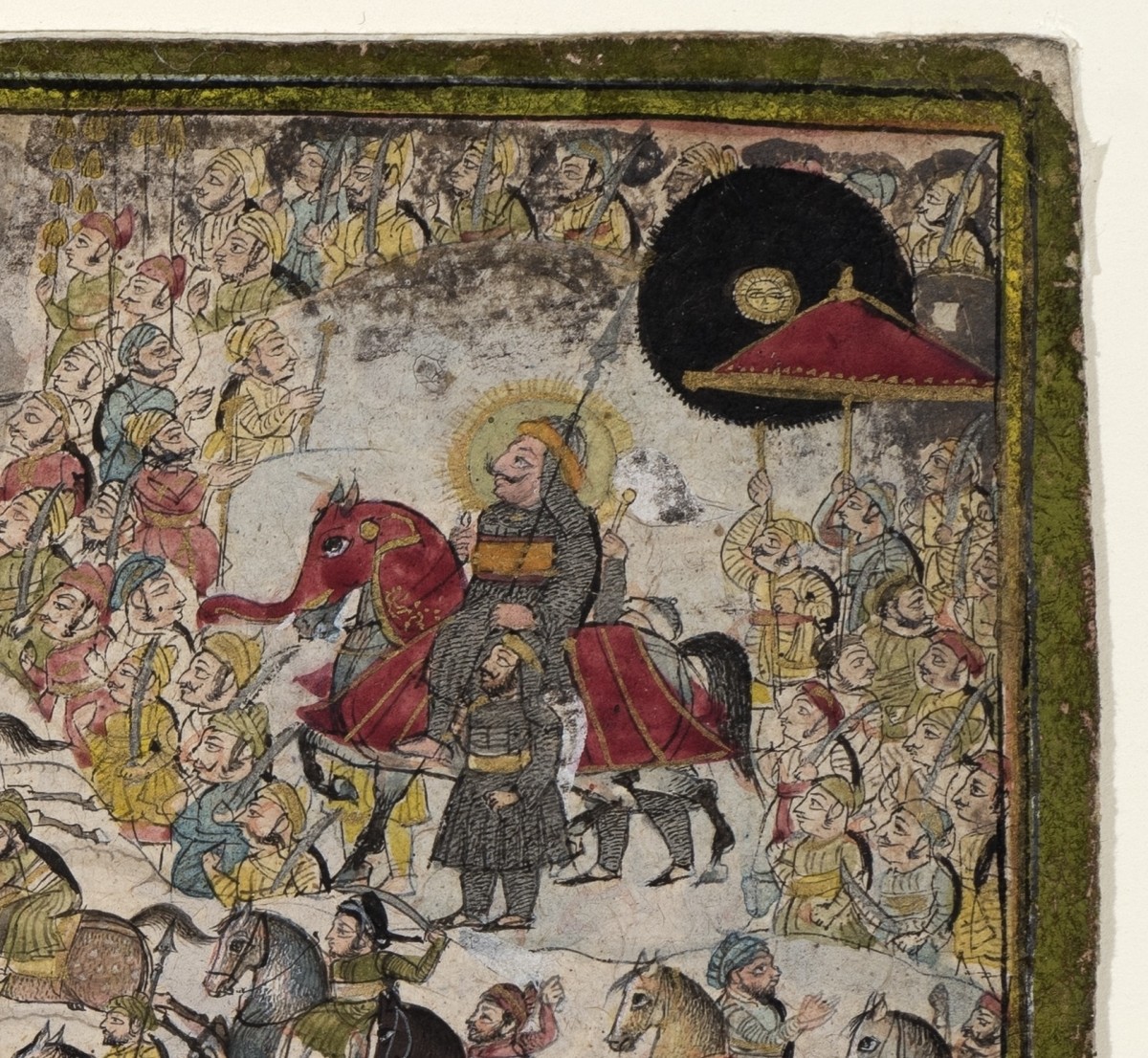
The other two scenes appear along the right-hand edge of the painting. At the top right, one witnesses Rana Pratap on Chetak first entering the field of battle. At his side, dressed in nearly identical chain mail appears another figure on foot. This Pratap doppelganger is Man Singh Jhala (a.k.a. Bida Man) who was famed for sacrificing his life in order to help Pratap escape the field of battle after his initial attack against the Mughal forces was repelled. In Pratap’s moment of mortal danger, Man Singh is said to have collected the Mewar regalia around him and rode away from Pratap to mis-lead the pursuing Mughal forces. The Mughal forces tracked down Man Singh and put him to the sword, but this sacrifice allowed Pratap to elude, at least momentarily, the danger.
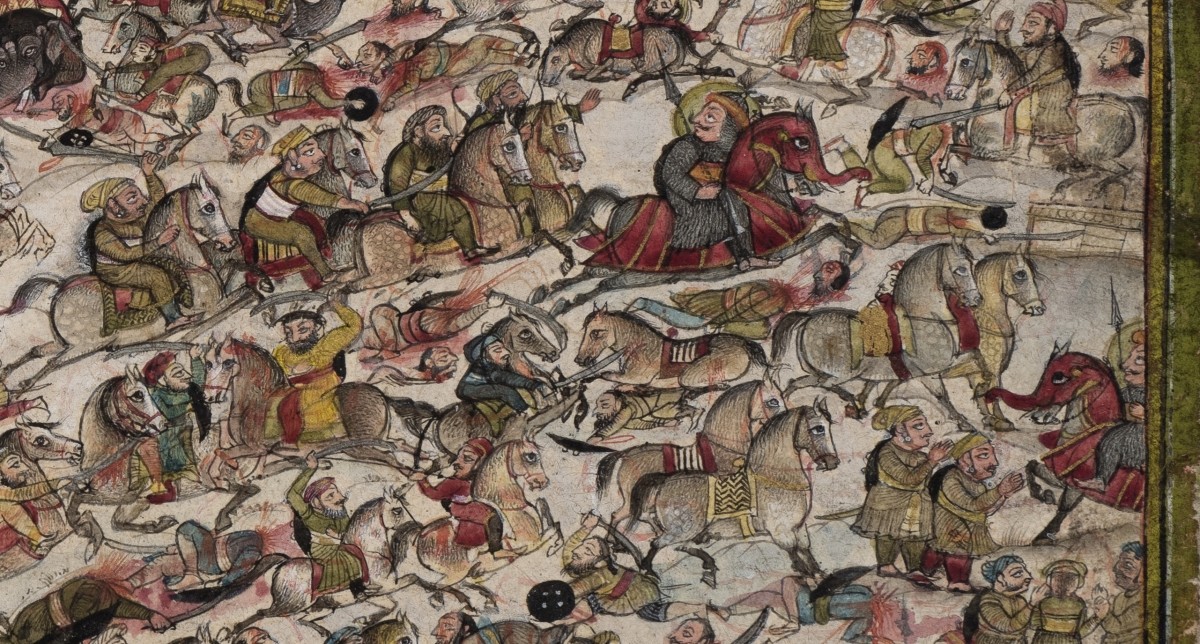
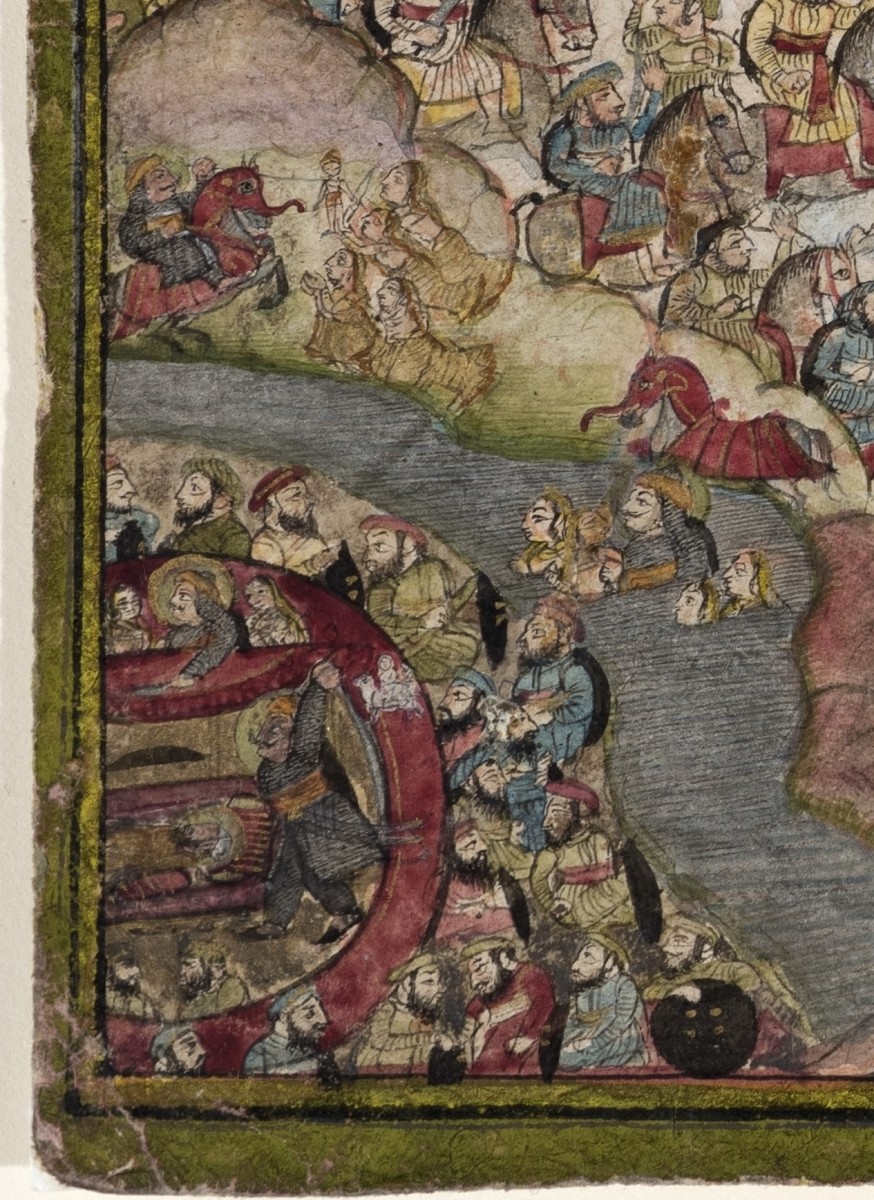
The lower right-hand corner of the painting depicts a second scene of exemplary loyalty towards Rana Pratap. In this scene Pratap’s younger half-brother Sagat Singh Sisodia (a.k.a. Shakti Singh Shaktawat) is shown hunting down two Mughal soldiers, known generically as Multani and Khorasani, who were pursuing Pratap. Sagat Singh’s actions are remarkable because he had been estranged from his brother and had been serving with the Mughal army. However, when he saw his brother’s impending distress, he switched sides to further facilitate his brother’s escape. The reconciliation between the two brother’s is touchingly depicted on the extreme righthand edge of the painting with Sagat bowing slightly while offering pranam to his brother. Just as the Bida Man episode celebrates the bonds of loyalty between political subordinates and superiors, this episode lauds the virtue of fraternal solidarity.
These familiar episodes, however, divert one’s attention from the perplexing, indeed unsettling, representation of the central ‘Mughal’ commander. This commander is clearly not Kunwar Man Singh of Amber, who is known from numerous contemporary historical sources to have commanded the Mughal army and is depicted in three of Chokha’s other paintings of the battle. Nor is he even the Mughal emperor Akbar who is named in folk sources as having been present at the battle and is depicted in another of Chokha’s Haldighati paintings.
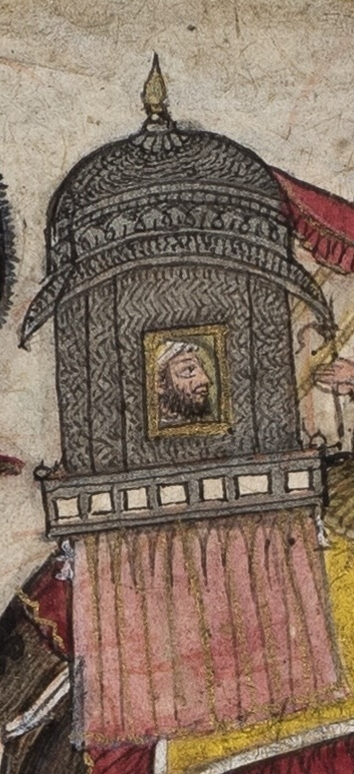
The figure in the howdah, bizarrely, appears to be Maharana Sangram Singh II of Mewar (r. 1710–34) who ruled a century and a half after Haldighati. This attribution is supported by the equestrian portrait in the upper left-hand corner of the painting which clearly shows Sangram Singh entering the field of battle on a horse surrounded by the distinctive regalia associated with the Mewar royal dynasty. Significantly, most of this same lawazma (regalia) also accompanies the person in the elephant howdah, who is depicted with the same profile and beard, white amarshahi pagri (style of turban), and green halo (prabha). How does one possibly interpret this anachronistic, narrative absurdity?
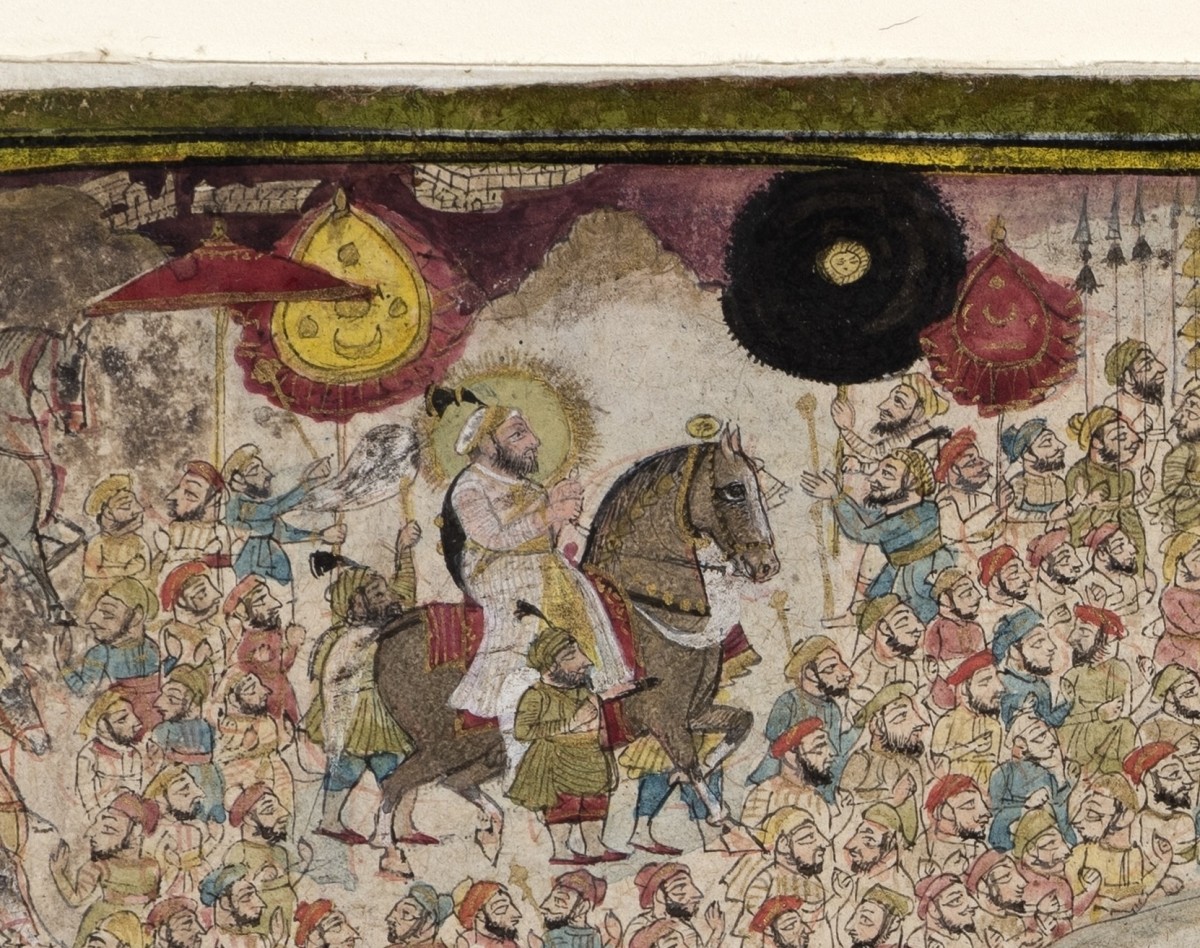
To address this question, it is useful to examine the circumstances of this painting’s patronage. The RAS painting was almost certainly painted for Lt-Col James Tod shortly before he left Udaipur for the last time on 6 June 1822, after having served for four years as the British Political Agent in Mewar’s capital. Tod brought the painting back to London and it was eventually bequeathed to the RAS where Tod served as Librarian later in life. Tod’s account books from his time as Political Agent show that he frequently employed Indian artists to depict people, events, and places that interested him. In fact, the Mewari artist Ghasi was seconded from the Mewar royal atelier to Tod’s service for at least two years on the salary of 5 rupees per month. Other artists, such as Chokha, appear to have been paid on a per painting basis.
When Tod left Udaipur to begin his long journey back to London, Chokha’s painting was still slightly unfinished as one can see from the fact that only a very few of the foot soldiers surrounding the central war elephant with howdah are shown carrying lances or swords. Most of these infantry remain disconcertingly empty-handed. Another feature that indicates that this painting was executed specifically for Tod is that it draws heavily on folk traditions, many of them oral, for its narrative of the battle. Although Tod is now mostly remembered as the first British ‘historian’ of Rajasthan, he probably should be considered more of a ‘folklorist’ of Rajasthan and was unusually interested in the tales that his Indian contemporaries told about the past. The ideal of strict historical accuracy was not central to his interests. To this end, Tod forged well-known, working relationships with contemporary local Charans (bards) such as Amra Badra and Kisna Ardha.
This interest in folklore informs the RAS version of the battle scene to an extent not witnessed in Chokha’s other versions of the same subject. The most notable instance of this interest can be found in the lower left corner of the painting. Here, in an enchanted sequence, one sees Pratap being conveyed across a river. Today, one is apt to remember Chetak as the vehicle who delivers Pratap across the river. However, in this painting Chetak is shown dying on the banks of the river before the crossing, and Pratap’s deliverance is enabled by four celestial yoginis and a small image of Siva. Once on the other side of the river, Pratap then stealthy cuts his way into the Mughal encampment where, finally, he is depicted in the act of cleaving his sleeping ‘Mughal’ adversary. This episode is based on longstanding legends popular in Rajasthan claiming that, in the years after Haldighati, Akbar suffered frightening nightmares in which he was directly confronted by a vengeful Pratap.
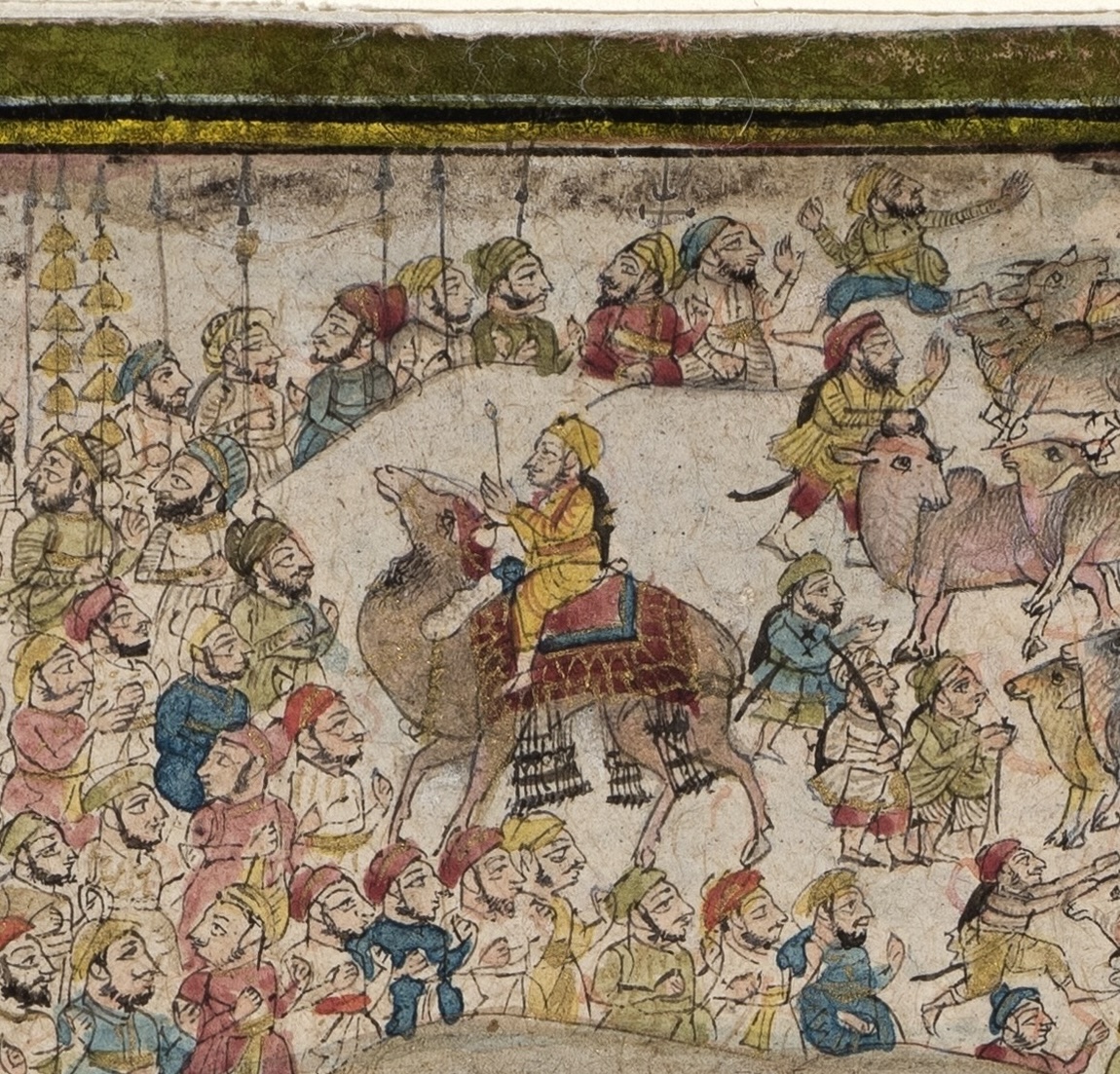
Interestingly, the appearance of Maharana Sangram Singh II in the upper left-hand corner of the painting offers a strong indication of the intended folkloristic interpretation of the painting. Sangram Singh II was a well-known for providing lavish patronage to Charans and had many serving in his court. One of the most famous was Karni Dan. Although Karni Dan is now most often associated with Jodhpur, earlier in his career he had served in Udaipur (amongst other places). In fact, one is tempted to speculate that the saffron clad figure on a camel performing pranam to Sangram Singh at the top-centre of the painting is none other than Karni Dan. The appearance of the famous Karni Dan and his royal Mewar patron alerts the viewer of the folkloristic emphasis of the painting.
However, Chokha does far more than highlight the popular dimensions of how the battle of Haldighati is remembered. He also appears to poke fun at Tod by having Sangram Singh II appear as Pratap’s nemesis and making nonsense of the battle’s storyline. In creating this bit of narrative chaos in his painting, one is tempted to speculate that Chokha was injecting a subtle, yet critical, subaltern commentary on Tod’s abilities to get the ‘facts’ of the battle straight.
Elsewhere in his artistic output, Chokha was known for his roguish humour. One sees this propensity especially in the corpus of paintings he produced on the firangi theme. These paintings tended to portray European visitors to the Mewar court as exotic, surreal, and often buffoonish beings. The RAS version of the Battle of Haldighati that was produced for Tod attests to Chokha’s sceptical opinion of Tod’s critical abilities.
Curiously, Tod himself never fully appreciated Chokha’s humour, or if he did get Chokha’s joke, Tod supressed the realization. In Tod’s description of the battle in his classic Annals and Antiquities of Rajast’han, Tod alludes to this painting but identifies the figure in the howdah as Prince Salim (later Jahangir). Despite being barely seven years old in 1576, Jahangir’s presence at Haldighati is claimed in several later literary sources and Tod appears to have shoehorned the unanticipated appearance of Sangram Singh II into the stock figure of Salim. Tod’s own narrative of the battle thus confirms Chokha’s critical estimation of his British patron.
Norbert Peabody